

Money's Not the Only Thing

Coming soon to a House near you: The first real look at how this bunch votes on tough issues.

The budget — and its companion, a supplemental appropriations bill — will hit the floor at the end of next week. That's the first potentially divisive material to reach the full House this session. It could provide some clues to the coalitions and combatants in legislative debates ahead over contentious issues like Voter ID, college tuition, unemployment insurance, and so on.

It'll also be a test of sorts for House Speaker Joe Straus, who won that office, in part, on a pledge to let members run the House instead of following a strong hand on the tiller.

The holiday break is the last one before the end of the session, and the prospects are pretty bleak for anyone who's not trying to kill legislation. The slow start and the crush of bills promise a gnarly traffic jam over the next few weeks.

Those ^%$#@*!!! Deadlines!

When this last legislative break is over, there will be seven weeks left in the session. And the last three of those form a procedural tourniquet that cuts the flow of bills until time's up. Here's the calendar, courtesy of the elves who make the whole machine function.
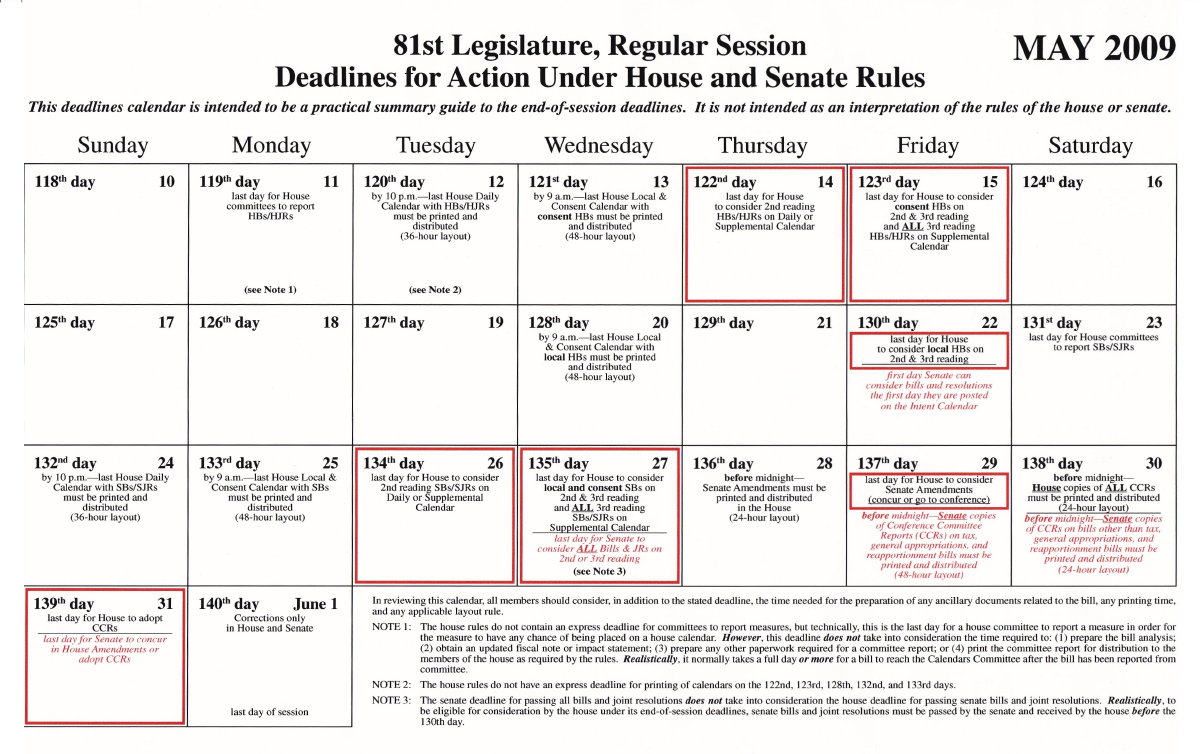
Click on the image to download a printable copy.

$178.4 Billion in Ten Minutes

In a 10-minute meeting, the House Appropriations Committee unanimously sent a $178.4 billion budget to the full House for a vote next week; a day earlier, that panel voted out a supplemental bill adding $3.3 billion in federal spending and subtracting $3 billion in general revenue spending to the current budget's total.

The panel earlier passed a separate supplemental bill that would spend $864.7 million to patch up Galveston and other areas ravaged by Hurricane Ike. Much of that funding is now in the supplemental bill.

Pitts is hoping to have that legislation in front of the entire House on Thursday of next week and the full 2010-2011 budget on the floor the next day. Pitts says he'll ready to go through the weekend on the budget debate if that's what it takes to pass the bill.

The House's proposed budget includes $11 billion in federal stimulus money and actually cuts general revenue spending (by using federal stimulus dollars where state dollars would otherwise have been used). Overall, analysts from the Legislative Budget Board told the panel that this version increases the budget by 5.1 percent over current spending, or about $8.7 billion over the next two years.

Last week, the Senate passed its version, which is bigger, spending $182.2 billion. Both versions leave the balance of the state's Rainy Day Fund alone (it's expected to total $9.1 billion at the end of the biennium), and neither included $556 million in federal stimulus funds for Unemployment Insurance, which the governor has said he'll oppose.

Details, Details

The supplemental appropriations bill totals $3.3 billion or $290 million, depending on whether you're counting spending or just the effect the bill has on general revenue. The former is how humans look at it; the latter is the way state budget-writers see it.

Whichever.

The fiscal note on the bill — HB 4586 — details the spending. Some highlights: The bill sends money to the state's junior colleges to pay for health benefits, a complicated and long-simmering issue between the schools and the state. There's money for salaries and wages and overtime and such — $125.1 million — at the state prison system. Almost $700 million is going into Medicaid and Medicare programs. And there's a good-sized list of spending related to damage from hurricanes and other natural disasters.

Much of the money is from the federal stimulus package, and the difference in those two spending numbers comes because state budgeteers are using stimulus money to supplant state spending. In effect, they're using federal money where they would ordinarily use state money, and leaving the state money in the Rainy Day Fund, which they hope to protect for two years. They expect to need that money more in two years than they need it now.

• The 2010-2011 budget includes money for bonuses of up to $1,000 for retired educators and state employees and a $1,000 bonus to state employees (not including state judges, higher education employees and some others), and a five percent pay increase for prison guards and others in the adult and juvenile prison systems.

The "wish list" of items that got into the bill but that don't have funding totals $14.6 billion.

As in the Senate plan, House budget writers used some of the federal stimulus money to leave the balance of the Rainy Day Fund untouched. They poured in $11 billion in federal funding and took out general revenue spending of $5.5 billion. They hope Comptroller Susan Combs' numbers hold and that that swap will leave $9.1 billion in the RDF for the next budget.

The Appropriations Committee version of the budget is here, and the more readable, less detailed summary of it is here.

What a Difference a Month Makes

Requiring voters to bring photo identification to the polls would cost the state $2 million, according to the fiscal note attached to the bill that came to the House from the Senate.

That's the amount, according to the note — a sort of financial impact statement — that the Secretary of State would spend to make sure Texas voters know what the rules are when they go to the polls.

"The bill would require the Secretary of State, in cooperation with appropriate nonprofit organizations and with certain political parties, to establish a statewide effort to educate voters regarding the identification requirements for voting. The agency estimates that this would cost $2 million out of General Revenue Funds for fiscal year 2010. The bill would make no appropriation, but could provide the legal basis for an appropriation of funds to implement the provisions of the bill, and a contingency rider for $2 million is included in the proposed Senate appropriations bill."

That's from an April 5 Fiscal Note. When the Senate voted, they were using the March 5 Fiscal Note. And that education program wasn't in the bill. But there was a discussion on the floor, when Senate Finance Chairman Steve Ogden said he had included $2 million in the state budget to pay for the SOS' new duty.

The voter ID hearing started off as you might have expected, with several members stating their positions for and against — the aginners were more vocal.

"We have found no documented cases of in-person at the polls voter impersonation... so, I ask, what is this bill about?" asked Rep. Rafael Anchia, D-Dallas. He went on to call low voter participation "the beast in the room" and suggested that's what lawmakers should work on.

Rep. Betty Brown, R-Terrill, was quick: "I just want to quote a senator... who said, 'We want to make it easy to vote, but hard to cheat.'"

And Rep. Mark Veasey, D-Fort Worth, called voter ID a racial issue. "Is this right?" he asked. "Can you really sleep with yourself at night knowing that most of he people who are going to be denied the right to vote are black or brown or poor?"

And then the members settled into hours of testimony from experts, with public testimony set for Tuesday. Weather forecast for that one: Expect scattered rallies and signage, lost citizens in the Pink Building, scarce to nonexistent parking in the area of the Texas Capitol, and a fair number of TV cameras.

Full Pot

If House members are going to vote on gambling this session, state Rep. Edmund Kuempel, R-Seguin, wants them to do it all in one vote.

With 16 gaming bills on his committee's agenda, Kuempel said his intent was to let folks have their say on all of it, then to put all of it into one omnibus gambling bill. His plan is to get the legislation out of the Licensing & Administrative Procedures Committee in a week or so.

What the omnibus bill will look like is anyone's guess. The bills under consideration run the gamut from relatively modest (local elections to legalize slot machines) to grandiose (Las Vegas-style resort-casinos).

Sheldon Adelson, CEO of Las Vegas Sands Corp., stole the show at the morning portion of the hearing, lasted into the evening after a break while the House was in session. If Donald Trump is seeking a mentor, a likely candidate for the position is Adelson, whose corporation is named after the iconic casino he razed to build his Venetian Resort Hotel and Casino. Adelson might have lost more money in the past 12 months ($22 billion, according to Forbes.com) than Trump has ever had.

Testifying in favor of HB 1724 and HJR 70 by Rep. Jose Menendez, D-San Antonio, (which we wrote about here) Adelson showed committee members glitzy renderings of his multibillion-dollar resort-casinos in Las Vegas, China and Singapore.

Menendez's bills would allow the construction of up to 12 casinos — seven in urban areas, two on the Gulf Coast and three to-be-decided later — plus one each for Texas' three recognized Indian tribes. The bill would also allow slot machines at racetracks. A minimum of 12 percent of gross slot revenues would go to increasing purse money for racing.

Adelson said if casinos are legalized, the state's major metros would be attractive candidates for his kind of destination resorts, complete with convention centers, hotels and restaurants; those, and not the gambling, are the real economic drivers for surrounding areas, he said.

Suzii Paynter, director of the Christian Life Commission, the ethics and public policy office for Texas Baptists, says she's not against the kind of economic development Adelson is proposing.

"We're all for convention centers, golf courses and hotels," she says. "Bring a resort. Just leave out the slot machines."

Paynter has three main arguments against proposed gaming legislation: 1) Casino proponents won't be able to follow through on their revenue estimates; 2) Legalizing slot machines may trigger federal law exceptions, allowing Indian tribes to construct full-blown casinos (also, she says, allowing casinos might entice some 27 out-of-state tribes with Texas connections to begin legal action to build their own casinos here); and, 3) What she calls "the predatory nature of the business model" of gambling, bringing addiction, bankruptcy and crime to surrounding communities.

At the other end of the spectrum from Menendez's broad legislation, HJR 99 by Rep. Chente Quintanilla, D-El Paso, would allow voters to approve gambling county-by-county, in the same way local voters have control over liquor laws.

Witnesses from the Kickapoo tribe near Eagle Pass are concerned that legalizing gambling elsewhere will hurt their gaming operations, the proceeds of which keep the tribal government operating. If casinos are legalized, the Kickapoos want to be able to establish their own casino off their reservation, presumably nearer to a major metro area like San Antonio.

Former state Rep. Pat Haggerty, R-El Paso, who's now a bingo lobbyist, wants slot machines allowed in bingo halls (and American Legion halls, etc.) if they're going to be allowed in places like casinos and racetracks, too.

Entergy II

The Texas Supreme Court, revisiting Entergy v. Summers, a controversial decision on a worker injured on that utility's property, landed in the same place they landed the first time. The court ruled that Summers, who worked for an Entergy contractor, doesn't have a case against the utility. At issue: Whether a premises owner who provides workers' compensation coverage for the employees of an independent contractor still has the liabilities of a premises owner, or is treated as a general contractor without that liability. The court chose the latter, in what amounted to a 6-3 decision.

The new opinion is here, with concurrence, another concurrence, and a dissent. The original opinion, from August 2007, is here.

The reactions? Labor called it a kick in the teeth and said the ruling "flies in the face of clear legislative intent." Becky Moeller, president of the Texas AFL-CIO, accused the justices of playing to their campaign supporters and ignoring the law. She got an echo from Texas Watch, which said the ruling "jeopardizes community and workplace safety, undermines corporate accountability, and ignores more than a decade of legislative intent."

Business groups were pleased with the new ruling. Dick Trabulsi with Texans for Lawsuit Reform said the court "ignored a firestorm of criticism from personal injury trial lawyers and followed the law as written. Courts should always interpret statutes to mean what the words of the statute plainly say, just as the Court did today." The Texas Association of Manufacturers agreed with that, saying the ruling "upholds a century of precedent."

Several pending legislative proposals would change the law to what the unions and their lawyers thought it was before the two Entergy rulings.

Flotsam & Jetsam

Judge Sharon Keller's hearings — she's accused of refusing a death penalty appeal because it came in after the 5pm closing time — will be held on August 17.

Convicted killer Michael Wayne Richard was executed by the state hours later. The State Commission on Judicial Conduct says Keller, the presiding judge of the Texas Court of Criminal Appeals, should be punished. She's the head of the state's highest criminal court. The highest civil panel — the Texas Supreme Court — chose state District Judge David Berchelmann Jr. of San Antonio as the "special master" to run the trial and to make recommendations to the commission. And that panel's decision could be appealed to the Supremes.

• The state's public school finance formulas need tweaking soon to keep that system from becoming unconstitutionally imbalanced, according to a report from the Legislative Budget Board. The LBB suggests lawmakers could put more money into school finance or change the formulas for doling out that money. The Legislature had a special session three years ago to bring that funding system into compliance with the Constitution. That's when they passed the current business margins tax and the current school formulas. But the repairs turned out to be short-lived; LBB estimates the difference between per student funding in richer and poorer school is increasing. What had been a 12.8 percent difference in 2006 has grown to an estimated 15.2 percent this year — nearly $900 per student. In a classroom of 25 students, that's a $22,500 per year difference, or enough to pay half the salary of a new teacher.

• That's not the only glum report from the Legislature's finance department — there's a new primer on teacher and state employee benefits, and the state's pension funds. The headlines, you've read: The big pension funds lost money in the market during the last six months, and retirees still gotta get paid. The proposed budgets for the next two years take care of the immediate expenses on pensions, but if the balances stay low, it's another potential hickey in a few years. And health insurance is in the report, too. This report, unlike the first one, doesn't contain recommendations. But some of the holes it describes are deep.

• Roger Williams, who's hoping to become the next U.S. senator from Texas, picked up endorsements from U.S. Rep. Kay Granger, R-Fort Worth, and from basketball coaching icon Bobby Knight, who retired after leaving the head job at Texas Tech University. The Granger pickup is a two-fer; she'd been mentioned as a potential replacement for Kay Bailey Hutchison herself, and this nod to Williams takes her out of it. Insert the usual caveat: Hutchison, considering a run for governor, hasn't quit yet and isn't required to do so even if she makes the governor's race.

• The federal stimulus will cost Texas 131,400 jobs by growing government at the expense of the private sector, according to a study done for the Texas Public Policy Foundation by Arduin, Laffer & Moore Econometrics. That report assumes federal help for unemployment insurance (opposed by the Guv and pushed by many lawmakers) would lead to permanent increases in UI taxes on business. They estimate the drag on the private sector would cost jobs, and recommend lowering taxes to free up business money so those businesses will increase employment in their part of the economy.

• Sales tax revenue for the state totaled $1.6 billion in March, down 3.8 percent from the same month in 2008. Comptroller Susan Combs blamed weakness in retail trade, mining and construction, and other sector. For the year-to-date, the numbers are still outpacing last year even with the March drop. For the first three months of this year, sales tax payments were up 1.9 percent over the same period the year before.

• Texas is fining the Plainview Peanut Co. $14.6 million for alleged food safety violations. Those problems were discovered after a salmonella outbreak traced to a Georgia company was blamed for nine deaths and hundreds of illnesses. The fine is apparently the largest ever levied by the Texas Department of State Health Services, but the treasury might never see the money: The company is in bankruptcy.

• Around lunchtime on April 16, students at the University of Texas plan to walk out of class and march on the State Capitol as a protest against legislation that would allow concealed handguns on state university campuses. We found out about it from management; they sent a memo to teachers to alert them to the walkout.

Political People and Their Moves

Dewey Brackin made partner in the government affairs section at Gardere Wynne Sewell’s Austin office. He's a former assistant AG and specializes in the food and beverage industry's dealings with regulators and lawmakers.

Gov. Rick Perry appointed John Chupp of Arlington to the 141st Judicial District Court, replacing Judge Len Wade of Fort Worth. Chupp's an attorney with the Guerrero Law Office; Wade's leaving the bench to join a Fort Worth law firm.

The Guv wants Olen Underwood of Willis to continue on as presiding judge of the Second Administrative Judicial Region for four more years.

Perry named Larry Holt of College Station to the Texas State Library and Archives Commission. Holt's an attorney.

Gerry Evenwel of Mt. Pleasant — the retired director of benefits for Pilgrim's Pride — is Perry's newest appointee to the Correctional Managed Health Care Committee, charged with developing a health plan for Texas prison inmates.

And Perry named Glyn Crane of Longview, Carolyn Harvey of Tyler, and Ann Schneider of Austin to the Aging and Disability Services Council. Crane is president of Troy Business Forms. Harvey is director of nursing at Behavioral Hospital of Longview. Schneider is a former nurse and founder of several healthcare businesses.

The Dallas-based Allyn & Co. won Pollie Awards — the Oscars of political advertising — for ads it did for state Sen. John Carona, R-Dallas, and for its campaign for Smoke-Free Dallas.

Quotes of the Week

Rep. Betty Brown, R-Terrell, talking about the difficulty of Asian-American monikers with a witness testifying before the House Elections Committee: "Rather than everyone here having to learn Chinese — I understand it's a rather difficult language — do you think that it would behoove you and your citizens to adopt a name that we could deal with more readily here?"

Rep. Leo Berman, R-Tyler, talking to the Austin American-Statesman about Voter ID legislation: "There's so much fraud that even the district attorney or the attorney general won't prosecute it. If they did, they'd have to stop prosecuting murderers and rapists."

Sen. John Carona, R-Dallas, on his push for local option taxes to pay for roads: "I won't be accused of sitting on my bottom and doing nothing. When we arrive here, we take the easy jobs and the tough ones. I do not want to be a talk-radio Republican. I want to be a problem-solving Republican."

Judge Eric Clifford of Paris, quoted in the Los Angeles Times about the decision to send Aaron Hart, who has an I.Q. of 47, to prison for 100 years on sexual molestation charges: "It was a sad situation. I was about to cry. The jury was crying. Everybody looked at everybody like, 'What the hell do we do?' The only option we were presented was prison. We don't have any facilities in the state of Texas for any type of care for somebody like that."

Former President George W. Bush, quoted in The Dallas Morning News on cleaning up after his dog Barney: "It dawned on me, for eight years I was dodging this stuff and now I'm picking it up."


Texas Weekly: Volume 26, Issue 14, 13 April 2009. Ross Ramsey, Editor. Copyright 2009 by Printing Production Systems, Inc. All Rights Reserved. Reproduction in whole or in part without written permission from the publisher is prohibited. One-year online subscription: $250. For information about your subscription, call (512) 302-5703 or email [email protected]. For news, email [email protected], or call (512) 288-6598.
 

The Week in the Rearview Mirror

Bloggers are skewering Rep. Betty Brown, R-Terrell, after she shot both her feet and stuck them in her mouth during a committee hearing on voter identification legislation. Other hot topics in the blogosphere include Gov. Rick Perry's re-avowal of Texas sovereignty, possible conflicts of interest and bills advancing as the clock winds down on the 81st Regular Session. Wrapping it up is a miscellany of other posts, including video of a great golf shot.

* * * * *

Hu-Dat?

Brown has said she's sorry for last week's verbal gaffe, which many people took to mean that Asian Americans should simplify their names to make it easier on English speakers.

Attorney Ramey Ko told KVUE's Political Junkie he appreciates Brown's apology but is still against the voter ID bill. Bay Area Houston posts a statement from the Asian American Democrats of Texas, and also makes up a fake statement that's not really from Brown.

Blables.com creates a fictional cartoon reenactment of the Brown-Ko exchange (and potentially offends another group of people in the process). Meanwhile, musings has video of the real conversation. And an In the Pink commenter notes that Academy Award winner Jamie Foxx (who changed his name from Eric Bishop) grew up in Terrell.

"You know, I was just thinking the other day that what this legislative session was lacking was a dose of absurdity," Off the Kuff says. "Not every name can be as straightforward and puritan as Bristol, Trig, and Trip [Palin], don'cha know," says mean rachel. According to readers of the Houston Chronicle's Texas on the Potomac, Brown's new nickname should be "Bubba" (the poll's open until the end of May).

Letters From Texas disses Brown in Chinese. Celebrity gossip blogger Perez Hilton takes note of the fiasco (as do Saturday Night Live and MSNBC, but their links weren't posted as this was written). And Rep. Trey Martinez Fischer, D-San Antonio, creates a "Betty Brown American Name Generator" and links to it on his Poli-Tex blog.

"Imagine telling a Polish American that his name needs a few extra vowels, just to make it easier to pronounce," says ABC13's Political Blog. "Stupid is as stupid does," says Swanky Conservative. And Junkie wins Headline of the Week Award with her entry titled, "I'm Changing My Name to Elise Hughes."

* * * * *

Pleading The 10th

Blue Dot Blues was on scene for a presser featuring Gov. Perry and Rep. Brandon Creighton, R-Conroe, about HCR 50, reaffirming Texas' sovereignty under the 10th Amendment to the U.S. Constitution. Here are video highlights from KUT's Notes From The Lege.

Postcards (toting a movie camera) asked Perry if rival U.S. Sen. Kay Bailey Hutchison was part of the federal government's expansion of powers. Yes! says the incumbent, promising a "long and distinguished list" of her actions promoting big government. Here's a response by Team Hutchison (from the Associated Press, quoted in the Houston Chronicle), via Rick vs. Kay.

Williamson Republic has details on the April 15 two-part "Tea Party" in Austin, in which Perry will be participating. And in other news, the Texas Legislature is taking steps toward ratifying the 23rd Amendment to the Constitution (poll tax ban), writes Chronic, the Austin Chronicle's blog.

* * * * *

Interest vs. Interest

Texas Watchdog is calling out Rep. Randy Weber, R-Pearland, for taking money from "energy-related interests" then filing HB 4012, which they say "would weaken public checks and balances on polluting industries." Bay Area Houston says Democrats will be to blame if the Texas Residential Construction Commission isn't fixed this session, for real this time.

Texas Observer Blog is astounded that former Texas Commission on Environmental Quality Executive Director Glenn Shankle would turn right around and work as a lobbyist for Waste Control Specialists, a company wanting to bury radioactive waste in West Texas, the licensing of which was approved by Shankle.

* * * * *

Ticking Time

Democratic senators held hands to symbolize their united opposition to an insurance sunset bill by Sen. Glenn Hegar, R-Katy, according to Burkablog. Later, Burka reports that Hegar is going to try again on Tuesday to pass the derned thing.

During a conference call live-blogged by Blue Dot Blues, Perry says he's backing sb 912 by Sen. Dan Patrick, R-Houston, which raises the margins tax threshold to a cool million dollars. Rep. Ryan Guillen, D-Rio Grande City, talks about five bills he laid out for committees last Monday on his El Wiri Wiri Blog. And Lone Star Times posts about local transportation funding bill SB 855 by Sen. John Carona, R-Dallas, wondering why it took "liberal democratic senator" Kirk Watson of Austin to propose an amendment requiring that the local funding elections be held in November during even-numbered years (when people seem to like voting).

* * * * *

Melting Pot

U.S. Attorney Johnny Sutton is calling it quits, says Tex Parte. The Bush appointee put two Border Patrol agents in the slammer for smuggler-shooting and sent former Texas Attorney General Dan Morales to jail for conspiracy and whatnot. Watchdog has announced the location and time for their Houston bloggers meet-up Tuesday on public information requests. And the state housing department plans to post a draft of its plan to allocate federal stimulus funds on "weatherization" by April 16, says Pollabear, who's got more details.

If you consider El Paso paradise (as we do), then there's trouble in there, specifically concerning state Reps. Marisa Marquez and Norma Chavez, according to NewspaperTree Blog. Meanwhile, Dallas.org swore they would shut down the blog in 2010 and now wants readers' ideas on what to do with the website, if they do indeed choose to close up shop. And Wednesday, winds knocked a couple of the Pink Dome's flags to half-mast, reports Postcards. The Guv's PR folks say the flags will stay removed until the south flagpoles are fixed.

The Cook Political Report says that 20 of Texas' 32 U.S. Congressional Districts are "VERY Republican" (+10 percentage points or more in the Red). Potomac says to thank former U.S. House Majority Leader Tom DeLay for that. U.S. Rep. Kay Granger, once a speculated-upon contender for the U.S. Senate in 2010 (or whenever KBH isn't there anymore), has taken herself out of the running by endorsing former Texas Secretary of State Roger Williams. And Texas Off the Record reminisces about former Lt. Gov. Bob Bullock's efforts to renovate the Texas State Cemetery.

Nearly a dozen superintendents have signed on to a letter to the U.S. education secretary complaining about how Texas lawmakers want to spend federal stimulus funds, reports the Houston Chronicle's Texas Politics. The supers want the feds to tell Texas it has to use the $3 billion to boost school funding, not replace state funding for education.

Finally, Texas Rainmaker posts video of pro golfer Vijay Singh skipping a ball across a body of water for a hole-in-one. Cool trick.


This edition of Out There was compiled and written by Patrick Brendel, who hails from Victoria but is semi-settled in Austin. We cherry-pick the state's political blogs each week, looking for news, info, gossip, and new jokes. The opinions here belong (mostly) to the bloggers, and we're including their links so you can hunt them down if you wish. Our blogroll — the list of Texas blogs we watch — is on our links page, and if you know of a Texas political blog that ought to be on it, just shoot us a note. Please send comments, suggestions, gripes or retorts to Texas Weekly editor Ross Ramsey.

A new poll says Lt. Gov. David Dewhurst is better known than former Comptroller John Sharp, who in turn is better known than Houston Mayor Bill White.

That survey, done by Global Strategy Group — a New York-based consulting and polling firm that has several Democratic and corporate clients — doesn't include any head-to-head results in a hypothetical race for U.S. Senate (at least none were released). But it tried to get a read on the "familiarity" of each candidate to voters. And incidentally, it was released to the press a couple of days in advance of the deadline for candidate campaign finance reports, a more reliable measure of how the competition is developing.

And the pollsters shanked White, saying he "appears to be a one-market candidate" who is better known than Dewhurst or Sharp in Houston but falls behind them everywhere else. They also tested some negative ideas about White and Sharp and conclude that White's the more vulnerable to attack.

Dewhurst, familiar to 55 percent of the voters surveyed, topped the list. Sharp got 41 percent, and White got 30 percent. The rest of the list: U.S. Rep. Kay Granger, R-Fort Worth, 25 percent; state Sen. Florence Shapiro, R-Plano, 25 percent; Dallas Mayor Tom Leppert, 23 percent; Railroad Commissioners Michael Williams and Elizabeth Ames Jones, 11 percent and 8 percent, respectively; and former Texas Secretary of State Roger Williams, 9 percent. Granger has endorsed Roger Williams for that spot, should it open up.

Give Shapiro points for best spin, putting this headline on the results: "SHAPIRO HAS HIGHEST NAME ID AMONG ANNOUNCED GOP CANDIDATES." Dewhurst, see, hasn't said what he'll do.

The current occupant is Kay Bailey Hutchison, who's looking hard at a race for governor against fellow Republican Rick Perry.

Pollster Jef Pollock didn't return calls seeking comment. The survey was done March 30-April 1, included 603 "randomly selected voters" and has a margin of error of +/-4.0 percent.

The details aren't available yet, but look at the totals: Former Comptroller John Sharp raised $2.5 million "in cash and loans" during the first three months of the year and Houston Mayor Bill White raised $1.8 million during that period.

Sharp wasn't dragging the sack until January; if you add in White's December numbers, they're about even: White's at $2.6 million to Sharp's $2.5 million.

The money might be accumulating, but there's no race yet. The two Democrats have their eye on the U.S. Senate position occupied by Republican Kay Bailey Hutchison, who has her eye on the governor's post occupied by Rick Perry.

It was the kind of event Ron Paul supporters dream of having.

More than 1,000 conservatives of differing stripes showed up at Austin City Hall for the first of two "tea party" protests scheduled in the state's capital. Similar events were taking place in about 600 cities across America.

Attendees toted an assortment of signs (more than a few recycled from Paul's run for President last year) against and for various causes, but one message summed up the sentiment of the crowd: "Big Gov't Sucks." (One man told us, "If you're not a right-wing extremist, you should be ashamed of yourself.")

A string of speakers — including incumbent Gov. Rick Perry and U.S. Senate explorer Michael Williams — skewered federal pork and dished out red meat.

Dressed as if he had just gotten back from a fishing trip, or a seminar on populism, a ball-capped, light-jacketed Perry greeted the crowd as "true patriots," championed the economic accomplishments of Texas and disparaged "the folks in D.C. rampaging through the halls of Congress."

He signed off with the signature valediction of former Democratic Lt. Gov. Bob Bullock, "God bless Texas."

Perry's message at the rally (the first of three he was scheduled to attend across the state) could presage an argument in his GOP primary contest against U.S. Sen. Kay Bailey Hutchison, assuming she runs.

Perry's involvement in the tea parties is an example of his efforts to consolidate the conservative base of the Texas GOP and tap into an anti-Washington sentiment now in vogue among Republicans, says former Hutchison aide Matt Mackowiak, now a political consultant who assures us he doesn't have a dog in the Perry-Hutchison fight.

"He's obviously trying to align himself as much as possible with the positive energy at the tea parties," Mackowiak says. "But I don't see him appearing at a rally one day in April having much impact on an election on one day in March next year."

Texans for Fiscal Responsibility's Michael Quinn Sullivan, one of the event organizers, says Perry is brandishing his ideological guns.

"I can't help but think in some ways that the Governor has done something politicians are not supposed to do. He has stepped out and drawn a line in the sand, and said, 'These are the things I stand by and judge my terms by them,'" Sullivan said.

Hutchison, meanwhile, donned her writer's cap with an op-ed letter in the Austin American-Statesman touting her efforts in office to rein in the Democratic-controlled U.S. Legislature. That letter is indicative of the sort of message Hutchison will try to communicate in the next year, Mackowiak said.

The Perry-Hutchison matchup will probably be one of politics versus personality, he said, predicting that Perry will corner the conservative wing of the GOP, while Hutchison's strength will be in attracting moderate voters to cast their lots in the open primary.

Texas Democrats, whose gubernatorial contenders now include 2006 independent Kinky Friedman, were paying attention to Perry. Party chair Boyd Richie sent out a statement calling him hypocritical for posturing against federal spending while accepting billions in stimulus dollars. Additionally, Perry's rejection of $556 million in unemployment insurance funds would force a tax increase on small businesses, Richie said.

"If tea party attendees want to talk about "tax and spenders," they ought to be protesting against Rick Perry," Richie said.

Rep. Dan Gattis, R-Georgetown, disagrees with that characterization, saying, "I have to applaud Gov. Perry. From the beginning, he was an early critic of stimulus funds and bailouts coming out of Washington, D.C."

Gattis attended the Austin event because he believes in the cause, he said.

"The federal system has run amok. That is one of the reasons I joint-authored HCR 50 [reaffirming Texas' sovereignty under the 10th Amendment]," Gattis said.

There is "some immorality" to the idea of passing on the cost of the federal stimulus to subsequent generations of taxpayers, he said. "There is not a special money tree in Washington."

Railroad Commissioner Williams was a big hit. Crowd members booed on cue when he dropped names like George Soros, Michael Moore and ACORN. They cheered when he referred to God and Abraham Lincoln.

He lashed out at President Barack Obama, saying, "The President said he was for hope and change. I just hope he changes."

Williams also criticized the federal government: "The fact is, Washington, there would be no tea parties if you weren't spending like it's a bachelor party."

Now that the tea parties are over, what are attendees going to do? "That is the question," Sullivan said. "Getting together for a rally is fun, but the point has got to be continued engagement," he said.

Toward that end, Sullivan, Perry and Americans for Prosperity Texas director Peggy Venable urged crowd members to sign up via text message to receive more information.

One of the remarkable things about the tea parties is that no single entity was in charge of them, Sullivan said. The morning protest in Austin was the product of collaboration among TFR, Venable's group, the Young Conservatives of Texas, the Texas Libertarian Party and others. The Texas GOP got involved late, and they gladly welcomed its participation, he said.

"The crowd was excited about being positive about who we are in Texas, instead of just being against Washington," Sullivan said.

— by a Texas Weekly Correspondent

Mental illness is a key factor in driving up correctional costs in Texas.

There are 42,556 offenders with a mental health diagnosis in prison, 55,276 on probation, and 21,345 on parole. Additionally, some 170,000 mentally ill inmates are admitted into Texas county jails every year.

Mentally ill inmates cost more to house and they stay longer. They are also more likely to recidivate.

Fortunately, there are policies that can reduce both the recidivism and cost associated with the mentally ill in the criminal justice system.

First, counties can divert mentally ill offenders from jail through programs that protect public safety while saving taxpayer dollars.

Bexar County has established a successful three-pronged jail diversion program that can serve as a model for other Texas counties.

First, it employs specially trained law enforcement personnel called Crisis Intervention Teams (CIT). These teams are often able to defuse incidents involving the mentally ill without an arrest. Participants in CIT programs spent on average two more months out of jail than non-diverted individuals, resulting in significant jail cost savings. While the largest Texas metropolitan police departments have CIT personnel, smaller police departments can create a CIT program through cooperatives with other nearby departments.

With Bexar County’s second prong, arrested offenders are screened for mental illness and, if not a threat to public safety, released on a mental health bond or to a treatment center. Screenings are conducted at the Crisis Care Center, a 24-hour facility that provides significantly quicker service at a lower cost than the emergency room. Once stabilized, offenders are released on a mental health bond. Because the wait for a trial date can be as long as six months, outpatient monitoring significantly reduces the utilization of county jail space.

Finally, Bexar County diverts such misdemeanants from jail through an initiative called MANOS, which includes intensive case management that consists of outpatient medication management and counseling.

Of the 371 offenders admitted to the MANOS Program, only 6.2 percent were re-incarcerated. This compares to a re-incarceration rate of 67 percent for mentally ill offenders without the intensive case management services offered by the jail diversion program.

Savings from Bexar County’s jail diversion program are estimated at between $3.8 million and $5.0 million per year.

The state can also take steps to address the impact of mental illness on the criminal justice system. About 2,500 probationers and 800 parolees participate in a state-funded initiative involving intensive case management and a smaller caseload with a specially trained officer.

The three-year re-incarceration rate is 15.1 percent for participating probationers is and 16.0 percent for parolees. In contrast, there is a 52 percent re-incarceration rate for mentally ill probationers and parolees who do not receive treatment. Increasing the number of probationers and parolees in this program could more than pay for itself through lower recidivism.

Another way to address mental illness in the criminal justice system is through mental health courts. Several Texas counties — including Bexar, El Paso, Tarrant, and Dallas — have established mental health courts in which a judge orders the defendant to obtain treatment and supervises his progress. A RAND Institute study found significant cost savings from mental health courts due to lower jail utilization.

Finally, defendants who are mentally incompetent to stand trial can be diverted from a state hospital. In 2008, the state launched outpatient competency restoration pilot programs. Taking Travis, Tarrant, Bexar, and Dallas Counties together, some 427 offenders are projected to be served in 2009. The total cost of these four programs is $2.16 million compared with the state hospital cost of $14.9 million based on an average cost of $35,000 per offender. Accordingly, it makes sense to expand these pilot programs to additional sites.

Mentally ill offenders will always pose a substantial challenge in the criminal justice system. But through initiatives like these, we can achieve our goals of enhanced public safety and reduced costs to taxpayers.

Marc A. Levin is Director of the Center for Effective Justice at the Texas Public Policy Foundation, a non-profit, free-market research institute based in Austin.


Texas Weekly's Soapbox is a venue for opinions, spins, alternate takes, and other interesting stuff sent in by readers and others. We moderate submissions to keep crazy people out, and anonymous commentary is ineligible. Readers can respond (through the moderator) to things posted here. Got something to submit? We're interested in everything from full-blown opinion pieces to short bits to observations or tidbits that have escaped us and the mass media. One rule: Your name goes on your words. Call or send an email: Ross Ramsey, Editor, Texas Weekly, 512/288-6598, [email protected].

Gambling is easy to bet against this session, but there's a very interesting spreadsheet floating around — the bones of the omnibus gaming bill promised by Rep. Edmund Kuempel, R-Seguin.

It's not in bill form, as far as we know, but the highlights would include casino gaming allowed in six major markets and on three island locations, with licensing fees of up to $50 million per casino. They'd be taxed at five to 15 percent — higher rates for smaller developments and lower rates for big ones, to encourage economic development.

Video Lottery Terminals — called VLTs in the industry and slot machines by the rest of us — would be allowed in horse and dog tracks and in places now licensed for bingo. That last bit means VFW rooms and churches could get up to five VLTs for each license held. Elsewhere, VLTs would be based on the square footage given to gaming in a given location.

Gaming would be allowed in properties owned by the state's three Indian tribes: the Alabama-Coushattas, the Kickapoos, and the Tiguas (though concerns about the Tigua governor's rap sheet have raised political questions about gaming there). And gambling purses would be set at 12 percent and allowed to drop only after Texas surpassed total gambling in other states.

That said, it's difficult to find lawmakers — sponsors, even — who'll bet much on getting the two-thirds votes needed to pass a constitutional amendment expanding gambling.

The governor wants to turn down $556 million in Unemployment Insurance money from the federal government, but the Senate doesn't see it that way. That chamber voted 22-9 to "modernize" unemployment to meet federal stimulus guidelines to get that money. Opponents fear the state will get locked into a more expensive UI program. The feds have said the state can change back when the money runs out, but the Guv and others doubt the state would go backwards once a more generous program has been put in place. Sen. Kevin Eltife, R-Tyler, and other supporters say the federal money will reduce the assessments on business for the insurance program and is well worth the $70 million to $80 million the changes add to the annual costs. All of the Senate's Democrats voted for the bill (one more vote is required to move it along); Republicans were split 10-9 in favor of it.

• The Supreme Court has revisited its controversial ruling in Entergy v. Summers — a worker's compensation case. And there are signs the Lege doesn't like the way that went. The House Business & Industry Committee voted unanimously for HB 1657, which would rewrite that law to make it clear that premises owners don't share the liability protections given to contractors who have worker's comp insurance.

• The Senate voted to "local option funding" to build local roads and that's on the way to the House. The 21-9 vote on Sen. John Carona's bill would allow local option gas taxes of up to 10 cents per gallon, and/or fees on vehicle registrations (including a new "road impact fee"), parking on government property, vehicle emissions, and driver's licenses. None of those things could take effect without a public vote in the affected areas. The locals would be barred from collecting more than they needed to pay for the projects they choose, and would have to stop collecting the taxes or fees once the projects were completed. The push for the bill started in the Dallas-Fort Worth area — Carona's home court — but would apply elsewhere as well. A constitutional amendment that would allow the money to go to road and rail projects — Sen. Wendy Davis, D-Fort Worth, carried that one — also passed. If the House likes that one, voters will have the final say.

• The Senate okayed starting a new state law school in Dallas four miles from the private one at Southern Methodist University. If the measure passes, and gets funded by the appropriators, there will be a University of North Texas at Dallas College of Law in that city's downtown.

• The People of Tort are warring over an asbestos/mesothelioma bill approved by the Senate. Short form: It changes the legal standards for linking asbestos in a product to the disease in a plaintiff. Labor and trial lawyers support the changes; the Texas Civil Justice League and Texans for Lawsuit Reform oppose them. That's on the way to the House. That tentatively passed in the Senate and has to pass one more hurdle before it moves on to the House.

• Mark Homer's HJR 53, which would replace the attorney general with the agriculture commissioner on the Legislative Redistricting Board, is out of committee and on the way to the full House. That's the five-member panel that draws political districts if the Legislature locks up and can't do so itself. Attorney General Greg Abbott declined invitations to testify on Voter ID legislation earlier in the session, reasoning that he might have to defend the state later and should stay off the playing field to avoid conflicts. Homer, a Paris Democrat, and Sen. Robert Duncan, R-Lubbock, say he should stay out of redistricting for the same reason. The Lege will attempt to draw new congressional, Senate and House districts during its next regular session, which will follow the 2010 national census. The LRB currently includes the AG, the lieutenant governor, the speaker of the House, the comptroller and the land commissioner. All five (and the ag commissioner, too) are Republicans.

• An ambitious and expensive pre-kindergarten bill that was languishing in spite of its adornments — more than 90 co-authors are signed on — is out of committee and on its way. Nobody seems to be against it, really, but two objections have slowed it. It's got a $300 million annual price tag. And while it would send money into the public schools, it would come with strings attached. School districts would rather have the money without the strings, so they can use it as they please instead of for a new program.

• And a bill finally reached the governor for approval, more than 90 days into the 140-day session. Worse yet, it was one of the "emergency" bills Perry designated for consideration early in the session. The bill would allow utilities to raise rates through the Public Utility Commission to rebuild what they lost in last year's hurricanes.

If Texas passes a Voter ID bill, it'll have to be approved by the U.S. Department of Justice or a federal court under the Voting Rights Act.Texas is one of several states covered because of a history of racial discrimination, and has to have federal approval when it changes its election laws. The Texas branch of the ACLU asked the feds whether they'd have a say, and got a letter back saying it would have to be cleared like any other change.

• Move Kinky Friedman from the "considering" square to the "exploring" square. He's looking at a second run for governor in 2010, this time as a Democrat. And he says he's serious this time, though he still wants to be funny (his letter is here). Friedman finished fourth in 2006, behind Rick Perry, Chris Bell, and Carole Keeton Strayhorn, running as an independent. This time, he says his heroes have always been Democrats, and says he'll support the Democratic nominee, whoever that turns out to be. Right now, he and Fort Worth businessman/lawyer/ambassador Tom Schieffer are the two names in the Democratic column. Friedman's treasurer is Abel Dominguez, a San Antonio attorney who helped in Democrat Victor Morales' campaign for U.S. Senate in 1996. And Friedman says he's getting advice from former Texas Agriculture Commissioner Jim Hightower.

• Railroad Commissioner and prospective U.S. Senate candidate Michael Williams has a list of 1,600 people he says are supporting his bid to replace Kay Bailey Hutchison when she resigns or her term is up. A few names you might recognize: Ernie Angelo Jr. of Midland, Merrie Spaeth of Dallas, and Richard Collins of Dallas. Add a few who can't vote but support him anyway: Newt Gingrich, Rudy Giuliani, Lynn Swann, and J.C. Watts.

One in six Texans think it's a good idea, according to Rasmussen Reports.In a new survey, the pollster found that 31 percent of Texans think the state has the right to take its basketball and go home, but that 75 percent think Texas should remain part of the United States. The quickie survey was inspired by Gov. Rick Perry's comments at an anti-government "Tea Party" rally in Austin. Perry, as quoted by the Associated Press: "Texas is a unique place. When we came into the union in 1845, one of the issues was that we would be able to leave if we decided to do that. My hope is that America and Washington in particular pays attention. We’ve got a great union. There’s absolutely no reason to dissolve it. But if Washington continues to thumb their nose at the American people, who knows what may come of that." The pollsters also took a peak at the coming race for governor (at least on the GOP side). Perry is viewed favorably by 55 percent of the voters. U.S. Sen. Kay Bailey Hutchison is viewed favorably by 67 percent. Republicans like both of them, the survey said: Perry got 78 percent, Hutchison 83 percent.

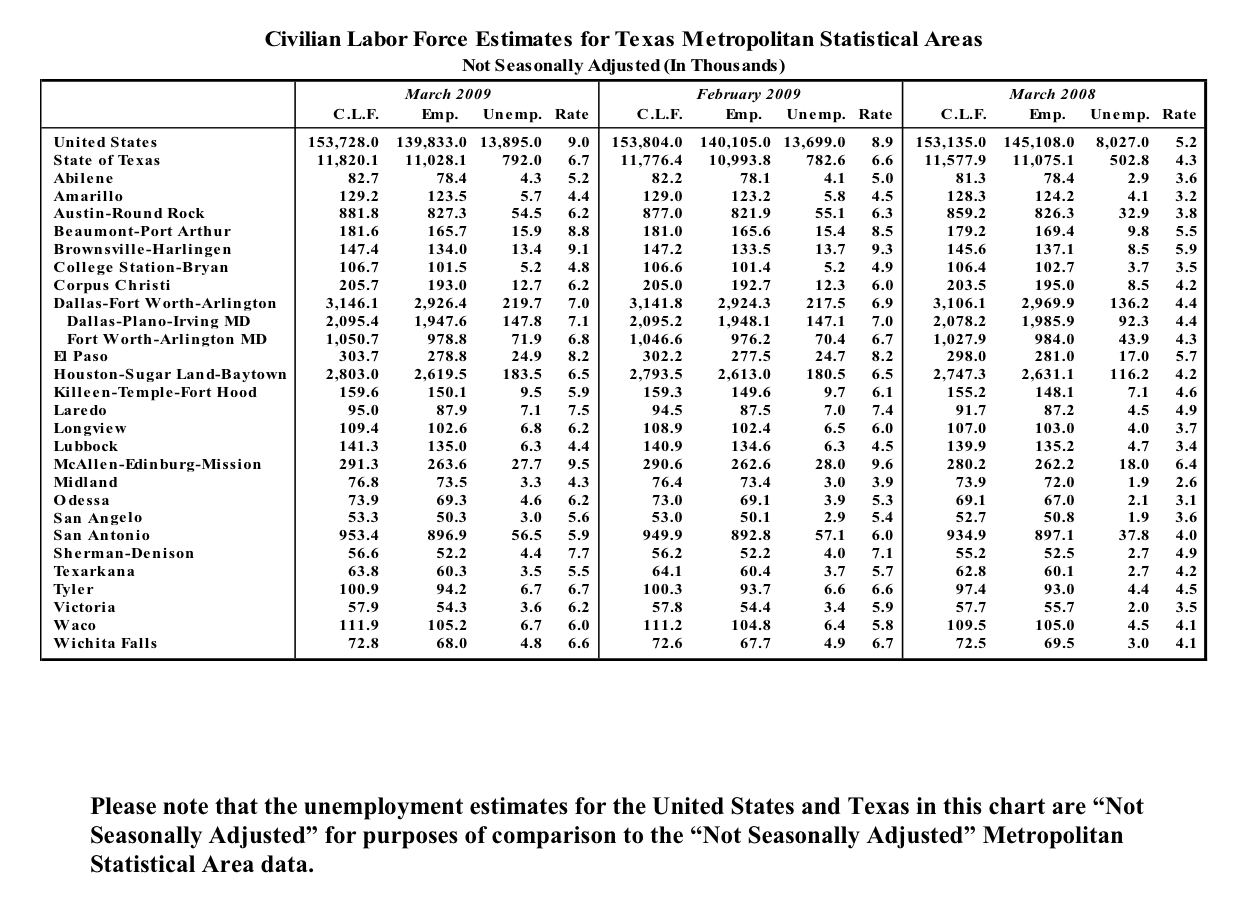
Unemployment rose to 6.7 percent in March in Texas, up from 6.5 percent in February and up from 4.6 percent in March 2008. The Texas Workforce Commission said 47,100 people lost their jobs in March, bringing the net job losses in Texas over the last 12 months to 106,500. Construction and manufacturing led the losses. The state gained jobs in trade, transportation and utilities, and in financial services. The lowest unemployment rate in the state was 4.3 percent, in Midland. The highest was in McAllen-Edinburg-Mission, at 9.5 percent.

After 18 hours of debate and consideration of 225 amendments, the Texas House unanimously approved a $178.4 billion budget that's almost $4 billion smaller than one passed earlier by the Senate.They finished at about 4 o'clock this morning. Next play: A conference committee to reconcile the two bills. The House voted down amendments on merit pay for teachers and publicly funded vouchers for private schools. And they added some things. The governor would lose money in the Texas Enterprise Fund if he decides not to take federal stimulus money for Unemployment Insurance. They voted to slash the governor's budget and use the money for veterans and the mentally ill.

Political People and their Moves

A promotion, a new firm, a new gig, and a half-dozen awards...

James Huffines is the new chairman of the University of Texas System's board of regents. His colleagues elected him to replace Scott Caven Jr. of Houston; this is the second time since he came on the board in 2003 that he'll serve as chair.

Victor Alcorta now has a door with his own name on it. Alcorta — former policy director for Gov. Rick Perry and general counsel in the Secretary of State's office — has been at Thompson and Knight for seven years. The new shop is called the Alcorta Law Firm.

Former Public Utility Commissioner Karl Rabago has landed at Austin Energy — the city-owned electric utility in the capital. His portfolio includes "energy efficiency, climate, green buildings, key accounts, market research, and advanced vehicle initiatives."

The Fort Worth-based Eppstein Group won six "Silver Pollies" for political advertising and design, from the American Association of Political Consultants. That's that industry's version of the Oscars. The company (which entered under that name but has since reformed into four separate divisions) won for work for the Tarrant Regional Water District, the Texas Farm Bureau, Dallas Water Utilities, and for a wet-dry election in Mesquite. They also got three honorable mentions.

Sutton and Sanders

U.S. Attorney Johnny Sutton is leaving that post to pursue a job he hasn't named in the private sector. He was George W. Bush's criminal justice wiz in the Guv's office, then worked for Bush in Washington before winning the prosecution appointment here in Texas. Sutton was pilloried by conservatives for prosecuting a couple of rogue Border Patrol agents who shot a suspect and tried to hide the evidence and cover up the incident. In another case, Sutton helped send former Texas Attorney General Dan Morales to prison for a variety of financial crimes.

Mark Sanders is back on Carole Keeton Strayhorn's payroll, this time for the last month of her campaign for mayor of Austin. She's been mayor before — from 1977 to 1983 — and now that she's been a state insurance commissioner, railroad commissioner, comptroller, and (third-place) candidate for governor, she's making another run at the muni level. Sanders, a political consultant for nearly 20 years, was her primary political advisor for the last few years, hadn't been involved in the mayoral race until now.

Quotes of the Week

Perry, Schieffer, Ellis, Hilderbran, Garza, Averitt, and Hardy

Gov. Rick Perry, on federal stimuli, states rights, and secession, quoted by the Associated Press: "There's a lot of different scenarios. We've got a great union. There's absolutely no reason to dissolve it. But if Washington continues to thumb their nose at the American people, you know, who knows what might come out of that. But Texas is a very unique place, and we're a pretty independent lot to boot."

Democrat Tom Schieffer, currently exploring a gubernatorial bid against Perry: "Talk of secession would be laughable if it weren't mentioned in a serious way. Texas certainly can't withdraw from the world. We can't withdraw from America. We can't roll up into a ball and pretend problems don't exist. This is not the time to build walls between Texas and the world. This is the time to find workable solutions to the problems we face."

Sen. Rodney Ellis, D-Houston, on the same subject: "Talking about state's rights, the oppressive hand of the federal government and secession brings up some pretty bad memories in this state. It was not all that long ago that those were the exact words used by those who opposed desegregation and the civil rights movement. The top elected official in the second largest state with our history simply cannot be so loose with his comments. He's not a radio or cable TV talk show host."

Rep. Harvey Hilderbran, R-Kerrville, on the slow pace of the session, in the Houston Chronicle: "We had a record number of bills introduced. That's the bad news. The good news is that probably a record number of them will fail."

Former U.S. Ambassador Tony Garza, asked by Texas Monthly what he'd do if Kay Bailey Hutchison resigned her seat and Gov. Rick Perry wanted to appoint Garza: "My response would be, 'Rick, I live in Mexico City. It seems like an odd place to choose a U.S. senator from.'"

Sen. Kip Averitt, R-Waco, on political squabbling at the State Board of Education, quoted in the Austin American-Statesman: "All I hear is that the Republicans want to push their religious views into the curriculum, and the Democrats want to teach our children how to masturbate."

SBOE member Pat Hardy, R-Fort Worth, on legislation that would strip the board of power, quoted in The Wall Street Journal: "As crazy as the Texas Board of Education is, there are just as many crazies, percentage-wise, in the state Legislature."