Up Next: The Ides of March

The "county fair" section of the legislative session — the part at the beginning that's taken up with glad-handing and rattlesnake roundup demonstrations and mariachis and pre-schoolers and city and county and association "days" at the Capitol — is coming to a close.

All that stuff will continue, but lawmakers are actually starting to work on legislation and the daily sessions of the House and Senate will soon involve more than resolutions and ceremony.

There are less than 90 days left, and it's time to get busy.

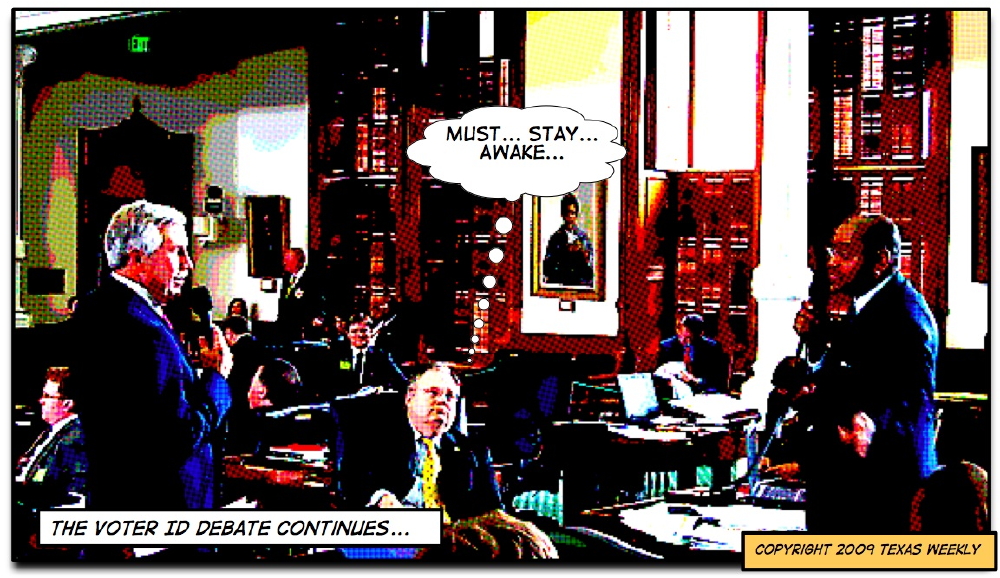
The Senate's going first, relighting its partisan firecracker on Tuesday: They're planning to convene the Committee of the Whole and talk about requiring photo IDs of voters.

That legislation outrages Democrats and excites Republicans, and it's a Republican Senate. Using the COW to consider the bill is part of a design to tiptoe around the Senate's two-thirds rule; if that were invoked, Democrats would have the numbers to block consideration. This way, they don't. All they can do is try to amend it in their favor or to the disadvantage of the Republicans.

Once the thing's out of the Senate, it goes to the House, which has voted on it before. It'll be tight, though: The House has 76 Republicans, two of whom voted against the legislation two years ago (Delwin Jones of Lubbock and Tommy Merritt of Longview), and 74 Democrats, several of whom are in districts where a vote against voter ID — party loyalty or not — is politically perilous. The so-called WD-40s — white Democrats over 40 who represent conservative and mostly rural areas of the state — could find themselves stuck between local and party politics. (Think of pols like Joe Heflin of Crosbyton, David Farabee of Wichita Falls, Mark Homer of Paris, Chuck Hopson of Jacksonville, Allan Ritter of Nederland, and Jim McReynolds of Lufkin.)

Democrats are scrambling for amendments that would make the bill more palatable if they don't have the votes to block. One idea floating: Add same-day voter registration to the bill. That's where voters have the right to register to vote on the same day they cast their ballots, right up until Election Day. Like voter ID, it's popular with voters. Unlike voter ID, it's popular with Democrats and unpopular with Republicans.

Jobbed

The state's unemployment rate rose to 6.4 percent of the workforce in January, according to the Texas Workforce Commission. That's up from 4.4 percent in the same month of 2008, and up from 5.6 percent in December.

The U.S. rate is higher still, at 7.6 percent.

"The national economic crisis is beginning to have a serious, negative impact on our Texas economy," said TWC Chairman Tom Pauken in a press release on the new numbers.

TWC counted 797,000 unemployed Texans in January, as against 542,300 in January 2008 (those are not seasonally adjusted numbers). The December 2008 number: 667,900. The highest unemployment rates in the state were in border areas — Brownsville-Harlingen, at 9.5 percent, McAllen-Edinburg-Mission at 10.1 percent. In the biggest urban areas, Austin, Houston, and San Antonio were all below the state average — doing better than the state as a whole — while Dallas-Fort Worth and El Paso had higher than average unemployment rates.

There's more economic trouble outlined in the Federal Reserve Bank's latest Dallas Beige Book, which starts with this assessment: "Outlooks remain pessimistic, and many contacts expect little improvement through year-end."

Grab that Hand or Bite It?

A group of legislative Democrats called on Gov. Rick Perry to drop his objections to $556 million in federal unemployment insurance money, prompting his office to say the Guv hasn't made up his mind.

Perry is among the critics of federal stimulus money that comes with strings attached. In the case of unemployment insurance, the state would have to change the requirements it puts on out-of-work Texans seeking the help. If it does, more than a half-billion dollars would flow into a fund that's already $750 million in the red, but the changes would add an estimated $80 million to the program's annual cost. It's not clear that the state would be able to drop those requirements (and costs) when the federal money runs out.

The alternative isn't that hot: Either raise the unemployment insurance taxes paid by employers, or borrow the money to keep the fund in the black (debts that would be paid by employer contributions later). The taxes would have to rise even if the federal money is accepted by the state, but they'd be cut by the amount of federal aid: $556 million.

The Democratic lineup in favor of the federal aid included Rep. Jim Dunnam of Waco and Sens. Rodney Ellis of Houston, Eddie Lucio of Brownsville, Eliot Shapleigh of El Paso, Leticia Van de Putte of San Antonio, and Kirk Watson of Austin.

"Well, you heard six of us say it: Number one, take all of the money. Number two, spend the money wisely," Ellis said. "This money is to be used to stimulate the Texas economy — not to supplant projects we were already going to do anyway."

Perry has expressed his reservations about the federal money on several occasions, but a spokeswoman said he hasn't made up his mind about the unemployment insurance funds. "It's unfortunate that today some legislators decided to inject politics into the stimulus discussion," said Allison Castle. "Despite the tone of today’s press conference and the fact that the governor has yet to make a decision, he looks forward to working with all lawmakers on this important issue to Texas families."

Overstimulated

The economy stinks and unemployment is rising, but it's a good time to be a trained auditor. Lookit:

The House's special committee on the federal spending package opened a "Texas Stimulus Fund" website to track the money that comes through the state government. That's actually only a fraction of the Texas-bound funds. The numbers have been a little squishy, but the latest estimates are that $16.7 billion in aid will go through the state government while a like amount comes into the state in the form of tax cuts for individuals and businesses. Almost $11 billion will be available to state and local governments through grants for programs like transportation, utility and water infrastructure, environmental and medical programs, and weatherization.

State Comptroller Susan Combs opened a spot on her website to make the stimulus spending transparent. It's detailed, too. As this was written, the site had a 23-page spreadsheet on the federal money and the state breakdowns, where available. She's promising to update that as things develop.

Texas will be one of 16 states targeted for bimonthly reports on stimulus spending by the federal Government Accountability Office. That agency got $25 million to watch the money, and they've worked up a list of states — California and Florida are among the others — that they'll keep an eye. The first report on that front is due in April.

And the State Auditor's Office is putting on its watchdog suit so it'll be ready to count the pennies that have gone through Texas to make sure they're going to the right places. SAO thinks the feds will want quarterly reports — this is apparently in addition to the GAO stuff, above — and that Texas lawmakers might expect the same. And they think the feds will want separate accounting for all of the state's ARRA funds (the official name of this thing is the American Recovery and Reinvestment Act).

The battle over transportation money in that package raged this week, with the Texas Department of Transportation basically making its own decisions about how to spend the money and the Legislature railing about the amount that's going to projects that support toll roads. The approval of TXDOT's plans appears to belong not to state lawmakers, but to the federal transportation folks who have to sign off on the Texas plan before they'll cut a check. Some of the objections from Texas lawmakers made it into the TXDOT package, notably, an acknowledgement that the spending targets economically distressed areas, among other things.

Atom's Eve?

Solar and wind energy proposals are stealing the show this Legislative session. Meanwhile, off the main stage, deals are in motion to make a former power source of the future — nuclear — an even more significant part of Texas' energy portfolio. But those plans could change amid environmental concerns and showdowns between corporate giants.

Nuclear power is the third-leading source of electricity in Texas, after natural gas and coal. In November 2008, natural gas and coal plants each produced about 40 percent of the state's electricity, according to the U.S. Energy Information Administration. Nuclear was next with 13 percent; about five percent came from wind and solar. Proponents of nuclear power argue that reactors are reliable, proven sources of electricity that are free from carbon pollution.

Texas now has two nuclear plants — the 2,725-megawatt South Texas Project near Houston, and the 2,300 MW Comanche Peak facility near Dallas. (By comparison, the City of Austin recently decided to build the world's largest solar panel array, at 30 MW, for about $250 million.)

Sen. Glenn Hegar, D-Katy, represents an area encompassing STP and a proposed Victoria County nuclear plant. Texas legislators are limited in what they can do to advance nuclear energy, compared to wind or solar, he says.

Nuclear power "is more of a federal issue than state. The most important thing the Legislature can do is continue to provide regulatory certainty in the restructured wholesale market," Hegar says.

Nuclear power "isn't a big part of my own personal agenda," said Rep. Mark Strama, D-Austin, chair of House Technology, Economic Development and Workforce. It's not that Strama's against nuclear power, he says — it's just that solar energy is more relevant to his district.

Perhaps the reason for state legislators' silence on nuclear power (no bills have been filed so far this session directly addressing the topic) is they consider their mission already accomplished.

"Didn't we do that last session with the decommissioning bill?" said an incredulous Janice McCoy, chief of staff for Senate Business & Commerce chair Troy Fraser, R-Horseshoe Bay. That legislation set up a funding mechanism for decommissioning nuclear plants in Texas' deregulated electricity market, effectively enabling the building of new reactors in the state.

Since that bill became law, applications for three projects in Texas have been submitted for federal approval. If all are okayed, the state's nuclear power production would triple in the next decade or so (A rule of thumb is that it takes about 10 years to go from application to functioning nuclear facility):

• Two new towers at STP would add an extra 2,700 MW of capacity. NRG (44 percent), CPS Energy (40 percent) and Austin Energy (16 percent) own the two existing towers. The new towers would be owned by CPS and Nuclear Innovation North America, a joint venture between NRG and Toshiba Corporation.

• Two new towers at Comanche Peak would add an extra 3,400 MW of capacity. The plant is owned by Luminant, formerly part of TXU Corp. Luminant (88 percent) and Mitsubishi Heavy Industries (12 percent) would own the two new towers.

• Exelon might build a brand-new plant in Victoria, consisting of two towers with a combined capacity of about 3,000 MW. Exelon will soon announce details on technology and capacity of the towers, said Bill Harris, a company exec. In 2010, Exelon will announce if it will pursue the project, Harris said.

Also, Amarillo Power and UniStar Nuclear Energy are pondering a two-reactor plant "at an undisclosed location near Amarillo," according to the Amarillo Globe-News.

None of those projects is a done deal, as corporations contend with a nationwide dearth of capital funding and opposition from grassroots groups. Texans for a Sound Energy Policy Alliance, formed by a wealthy land-owning family in Victoria to fight the proposed Exelon plant, contends that the Guadalupe River isn't an adequate source of water for a nuclear facility.

"The group is not anti-nuclear," executive Director John Figer says. "We're more site-specific about the proposed nuclear plant in Victoria County."

Echoing Figer's water worries is Karen Hadden, executive director of the statewide Sustainable Energy and Economic Development Coalition. She also cited radioactive waste, radioactive leaks, security concerns and monetary cost as major problems with nuclear plants.

"Texas has such a wealth of wind and solar potential that it makes no sense to pursue nuclear, which is a really an energy form of the past," Hadden said.

Activists aside, the energy companies themselves might stand in the way of new nuclear production. Exelon has been attempting to take over NRG, which recently announced it will acquire Reliant's retail electric provider business. It's not clear that Exelon would pursue its Victoria plant if it successfully buys NRG (along with NRG's stake in STP).

After the NRG-Reliant announcement, Rep. Sylvester Turner, D-Houston, sent out a letter saying the transaction thwarts the intent of electricity deregulation legislation. Turner is calling for a Public Utilities Commission of Texas review of the deal.

Schieffer Jumps In

Former U.S. Ambassador and Texas Rep. Tom Schieffer says he's formed a committee for an exploratory run for governor. He said Texans are worried about the economy, education, health care, and "the effects of a state government that has become more ideological, more narrow and more partisan than it needs to be."

The Fort Worth businessman says he's been encouraged in early conversations with friends and fellow pols and wants to extend the inquiry to voters. If they're amenable, he'll drop the "exploratory" and run a full campaign for the Democratic nomination.

Schieffer was a Democrat in the Texas House, but says he voted for George W. Bush for governor and for president because "he is my friend and business partner." The two were in a partnership that owned and operated and then sold the Texas Rangers Baseball Club. And Bush appointed Schieffer as U.S. Ambassador to Australia and, later, to Japan. Bush ran against Democrats Ann Richards, Garry Mauro, Al Gore, and John Kerry; Schieffer said he voted for Bush each time. He also said, however, that he's given more money to Democrats than to Bush, and that he voted for Barack Obama both in last year's primary and in the general election. And he said he ignored several opportunities to switch parties and become a Republican.

No Obligation Trial Offer

Legislators who want to run for governor don't have to resign to do so, and don't have to resign if they're "exploring" such a run, either.

Attorney General Greg Abbott says neither the law nor the constitution prohibits it, so it must be legal.

The question in this case originated with Rep. Leo Berman, R-Tyler, who has said on several occasions that he'll run for governor if the Legislature doesn't crack down on undocumented aliens living and working in Texas. But it could affect others; Sen. Leticia Van de Putte, D-San Antonio, says she'll take a look at a run for governor once the session ends in three months.

Berman had asked if a resignation was required if a House member declared for Guv in the first year of his or her two-year term. It doesn't matter when they run or explore or declare, according to Abbott: They're not required to quit the Legislature.

Rent Control

Former legislator Toby Goodman didn't break the law by using campaign funds to rent an Austin residence owned by his wife, a court rules.

State ethics officials accused Goodman of breaking laws that are supposed to prevent elected officials from enriching themselves with campaign funds. Goodman, relying on an official opinion from the Texas Ethics Commission, paid market-rate rent to his wife for a property that she owned separately from him.

And now state district Judge Randy Catterton of Fort Worth says Goodman was following the law because he relied on the TEC opinion, because there was no argument that he owned a share of the property himself, because the rent wasn't at an above-market rate, and because state officials didn't show that any of the rent money actually went to pay the mortgage on the property (a mortgage that included Mr. Goodman's name).

The judge issued a summary judgment — attached here — last week.

Worst Face Forward

While the U.S. Supreme Court mulls the link between campaign contributions and judicial decisions, a new study posted by the Center for Public Integrity tracks the phenomenon in several states (including Texas) and concludes that there is sometimes a correlation between contributions to a judge's campaign and how the judge decides cases.

Wallace Jefferson, chief justice of the Texas Supreme Court, has joined the ranks of Texas judges who want to unlink campaigning and judging and any appearances of conflicts; lawmakers are making a fresh attempt at judicial selection reform.

In the meantime, this new study includes this zinger in its abstract: "While we do not find any evidence of a relationship between contributions and the votes of judges in Nevada, it does appear that there is a quid pro quo relationship between contributors and votes in Michigan and Texas." And this one: "While we only examine three states and one year here, the results suggest that there may be circumstances where the appearance of impropriety surrounding campaign contributions and judicial decision-making may be an empirical reality."

They didn't cite particular opinions where the state's high court rewarded contributors. Instead, they're relying on statistical analysis based on the outcomes of cases and the contributions from the lawyers and parties involved.

What they didn't find: Whether decisions follow dollars (corruption) or dollars follow decisions (political philosophy). That, according to the authors (Chris Bonneau at the University of Pittsburg and Damon Cann of Utah State University), needs more study.

Google Me, and Other Stories

Rep. Joe Deshotel, D-Beaumont, filed a bill that would make it illegal to "publish through the Internet, or cause to publish through the Internet, an image capable of zooming into greater detail than that of an aerial photograph taken without a magnifying lens 300 feet or higher of private property not visible from the public right-of-way." No closer, for instance, than this.

• The company that runs Lone Star Park — that's the horse track in Grand Prairie — filed for bankruptcy, but the actual owners of the track told The Dallas Morning News they'll open for racing next month, as planned. Magna Entertainment Co. filed for Chapter 11 bankruptcy protection.

Ted Cruz, the state's former solicitor general, now has a website where he can collect names of supporters and giving them information and all that. He hopes to seek the Republican nomination for attorney general if his former boss, AG Greg Abbott, leaves that post to run for U.S. Senate or something else.

• The National Journal's rankings of congress from most conservative to most liberal is out (and on the free part of their website, too). Some highlights: U.S. Rep. Jeb Hensarling, R-Dallas, came out in a three-way tie for most conservative member of the House. Sheila Jackson Lee, D-Houston, was the most liberal member of the Texas delegation and ranked 13th overall in the 435-member House. On the Senate side, Texas Republican Kay Bailey Hutchison is 20th most conservative, and John Cornyn ranks 17th.

• The Houston Chronicle asked the state what it paid employees in 2008 and made a must-see searchable database of it. We typed "executive director" into the blank for job titles, and found two agency heads making over $200,000, a couple more making less than $200,000 but more than $150,000, and another 22 making between $100,000 and $150,000. Same game, with the "commissioner" title: One over $200k, seven under $200k and over $150k, and 19 more between $100k and $150k. And if you just search for the highest salaries, you'll find 16 people making more than $250,000 on the state payroll, led by Thomas Harris, chief investment officer at the Teacher Retirement System, at $434,680; 11 of the 16 are doctors and psychiatrists who work for the state.

• Gov. Rick Perry will have Tony Garza's support in his race next year against Kay Bailey Hutchison. Garza told Texas Monthly he'll stick with the incumbent.

• By the Census Bureau's reckoning, one in five adult Texans didn't finish high school — roughly 3 million people. About half of those didn't make it to ninth grade. And the Texas Education Agency reports that 55,306 students dropped out in 2006-07 — the most recent numbers available. That's got lawmakers talking about career and technical education programs (what were until recently called vocational education) in and after high school. The idea is that some folks just don't want or need to go through traditional college classes or college prep. Several pieces of legislation from Sen. Florence Shapiro, R-Plano, Rep. Rob Eissler, R-The Woodlands, and others would reward high schools that offer CTE courses that sync with college and the job market. Other legislation would set up college and junior college training for adults who need technical and/or remedial classes.

The two lawmakers — who chair the public education committees in each house of the Lege — also want to replace high-stakes standardized tests in elementary and high school with a series of end-of-course and other tests that measure progress along the way. They've got support from the Texas Association of Business and some other groups. Teacher groups are more skeptical. The Texas Federation of Teachers say there's still too much reliance on standardized tests.

Political People and Their Moves

Former Rep. and utility lobbyist Curt Seidlits is starting a new public affairs firm he says will combine traditional lobbying and consulting with the Internet and new media tools. The firm — Focused Advocacy — will be based in Austin. Seidlits was at the former TXU for more than a decade.

Becky Moeller was elected president of the Southern Region of the AFL-CIO and keeps her gig as president of the Texas AFL-CIO. The new duties include serving on the union's general board.

Robert Peeler joins the Austin office of the El Paso-based Kemp Smith law firm, where he'll work on legislative and regulatory issues. The former UT football player was chief of staff to Sen. Mike Jackson and has had his own law practice for the last couple of years.

Getting hitched, no date set: Lt. Gov. David Dewhurst and Patricia "Trish" Bivins, the ex-wife of former Sen. Teel Bivins of Amarillo.

Recovering: Former First Lady Barbara Bush, after heart surgery in Houston. Doctors replaced her aortic valve and expect to let her out of the hospital in a week or so.

Deaths: Jamie Hager Clements, billed as the youngest pol ever elected to the Texas House (at age 20), and a former mayor of Temple, and the top attorney for Scott & White, at age 78.

Quotes of the Week

Gov. Rick Perry, talking about the Mexican drug wars, quoted by the Newspaper Tree (El Paso): "The issue of how long this will last I think is really directed more to the federal government of the United States and if they're going to engage in a substantial way. I think this could be put to bed rather quickly. When you think about the number of billions of dollars the United States government has committed to a war in Iraq and a war in Afghanistan, a very small amount of that directed to this war against these drug cartels could end that war very quickly."

Democrat Tom Schieffer, asked whether he'll self-finance any or all of his bid for governor: "This is not an ego trip for me and I think you have to go to people and try to find support, and if you can't find that kind of support, that tells you something. So I'm going to try to raise the money."

Schieffer, on voting for George W. Bush twice for governor and twice for president: "He was my friend and he was my business partner, and I kind of put a little special niche in there for friends."

Rep. Jim Dunnam, D-Waco, urging Gov. Rick Perry to accept federal stimulus money for unemployment insurance: "I don't pay my federal income taxes to send the money to Wisconsin."

Chris Lippincott of the Texas Department of Transportation, disputing a House chairman's assertion that federal highway funds are supposed to favor economically distressed areas, quoted by the Associated Press: "I'm not sure Representative Dunnam understands what the law says. Federal law can be complicated."

Denver Mayor John Hickenlooper, quoted in the Washington Post on the demise of The Rocky Mountain News: "Even when they were uncovering corruption in the city, even when they were embarrassing us or causing us discomfort, they were making the city better. It's a huge loss."

Rep. Susan King, R-Abilene, promoting vocational education: "If you're not college material, it doesn't matter. You're something material."


Texas Weekly: Volume 26, Issue 9, 9 March 2009. Ross Ramsey, Editor. Copyright 2009 by Printing Production Systems, Inc. All Rights Reserved. Reproduction in whole or in part without written permission from the publisher is prohibited. One-year online subscription: $250. For information about your subscription, call (512) 302-5703 or email biz@texasweekly.com. For news, email ramsey@texasweekly.com, or call (512) 288-6598.

 

The Week in the Rearview Mirror

The Texas Senate relights its partisan firecracker next week: They're planning to convene the Committee of the Whole and talk about requiring photo IDs of voters.

That legislation outrages Democrats and excites Republicans, and it's a Republican Senate. Using the COW to consider the bill is part of a design to tiptoe around the Senate's two-thirds rule; if that were invoked, Democrats would have the numbers to block consideration. This way, they don't.

Once the thing's out of the Senate, it goes to the House, which has voted on it before. It'll be tight, though: The House has 76 Republicans, two of whom voted against the legislation two years ago (Delwin Jones of Lubbock and Tommy Merritt of Longview), and 74 Democrats, several of whom are in districts where a vote against voter ID — party loyalty or not — is politically perilous. The so-called WD-40s — white Democrats over 40 who represent conservative and mostly rural areas of the state — could find themselves stuck between local and party politics. (Think of pols like Joe Heflin of Crosbyton, David Farabee of Wichita Falls, Mark Homer of Paris, Chuck Hopson of Jacksonville, Allan Ritter of Nederland, and Jim McReynolds of Lufkin.)

Democrats are scrambling for amendments that would make the bill more palatable if they don't have the votes to block. One idea floating: Add same-day voter registration to the bill. That's where voters have the right to register to vote on the same day they cast their ballots, right up until Election Day. Like voter ID, it's popular with voters. Unlike voter ID, it's popular with Democrats and unpopular with Republicans. Meanwhile, here's a primer on the policy fight.

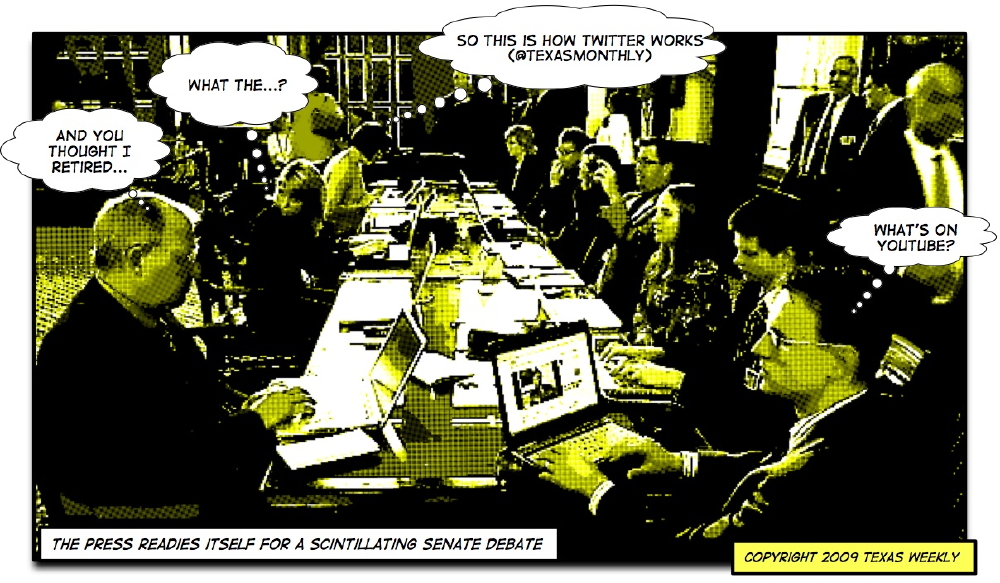
Cast of characters: The Senate press corps

The hyped debate over Voter ID legislation started with a parliamentary debate and then a stall while the Senate decided whether its rules would let the show go on. The hearing started Tuesday morning; the first witness started after 6 p.m.

The debate started with quibbling over whether Attorney General Greg Abbott should come talk to the Senate. An aide to Abbott was quoted saying the AG had been advised by the chairman of the committee to stay away. But the chairman, Sen. Robert Duncan, R-Lubbock, said in response to questions from other senators that that wasn't true: "No, I did not request the attorney general to refuse to appear."

But he also said the AG "shouldn't be a witness in a legislative debate if he might have to defend" the issue later in court.

The main hangup: Whether a change in the starting time of the debate was officially posted far enough in advance. If not, they'd put it off. If so, they'd proceed, eventually. Duncan ruled they should go ahead and after a skirmish over that, they did.

Sen. Troy Fraser, R-Horseshoe Bay, fended off questions from his Democratic colleagues, reiterating his position that the bill doesn't suppress Democratic, elderly, and minority votes. Sen. Wendy Davis, D-Fort Worth, wanted to know if the bill would require people to pay for the IDs required to vote, and if that amounted to paying for the right to vote. At one point, Fraser stopped her and said, "I have trouble hearing women's voices." While some in the room tittered, he put on a headset to improve the situation, and continued from there. Sen. Judith Zaffirini, D-Laredo, wondered why the bill has no fiscal note indicating the cost of checking IDs, like similar legislation had two years ago. Fraser said legislative budgeteers had revised their thinking.

It was anything but a speedy hearing. Senators took eight hours to lay out the bill, try to score points for their sides, and to finally get to the first witness — which happened around dinner time. Their plan: To hear from 15 invited witnesses, give each of those 10 minutes and then open it up for questions. And since this is taking place before the Committee of the Whole — the entire Senate — other committees, like Finance, are blocked from meeting while the Voter ID bill is up for consideration.

The first guy up for the Republicans — Hans von Spakovsky — has some Texas history. In the 2003 redistricting fight, the staff attorneys at the U.S. Department of Justice opined that the Texas political maps were illegal under the Voting Rights Act. They were overruled by their superiors — a group that included von Spakovsky. That plan was later ruled unconstitutional by the U.S. Supreme Court and sent back to Texas for alterations.

He said Voter ID would prevent a type of fraud that goes largely unreported because there aren't Voter ID requirements in place to catch it. He cited a New York grand jury investigation that caught a voter impersonation operation in the mid-1980s.

In the leadup to the debate on Voter ID, both sides were trying to gin up support. Judging by the relatively small size of the crowd in the Senate gallery, this is of more interest to insiders than to the humans outside the Capitol.

• A Friday Twitter "tweet" from Gov. Rick Perry, repeated throughout the weekend: "Citizens needed at the TX Capitol South steps next Tuesday at 7:45 in the morning... wear red & testify for Voter ID."

• The Texas Democratic Party emailed supporters and asked them to stop by the Pink Building to sign cards expressing opposition or to sign up and testify. Their version: "This legislation places bureaucratic hurdles between you and the ballot box and is part of a national Republican campaign to suppress the vote and keep failed leaders in office."

• The Republican Party of Texas got into the act, too, writing, "Just like Colonel Travis drew his line in the sand at the Alamo... the battle lines have been drawn in the Texas Legislature. Despite huge bipartisan support for Voter ID legislation, Texas Democrats are determined to keep it bottled up once again this session." They also asked supporters to stand up and be counted.

• The Texas branch of the American Civil Liberties Union weighed in, too, asking opponents of the bill to show up at the capitol.

• A spokeswoman for the League of Women Voters said at a press conference that the Legislature shouldn't waste precious time in a busy session with this legislation. Scorecard: In the first 55 days of the 140-day session, the House hadn't yet passed any bills out of committee; the Senate had its firs bill of the year on the floor that day.

Cast of characters: Troy Fraser, Craig Estes, Rodney Ellis

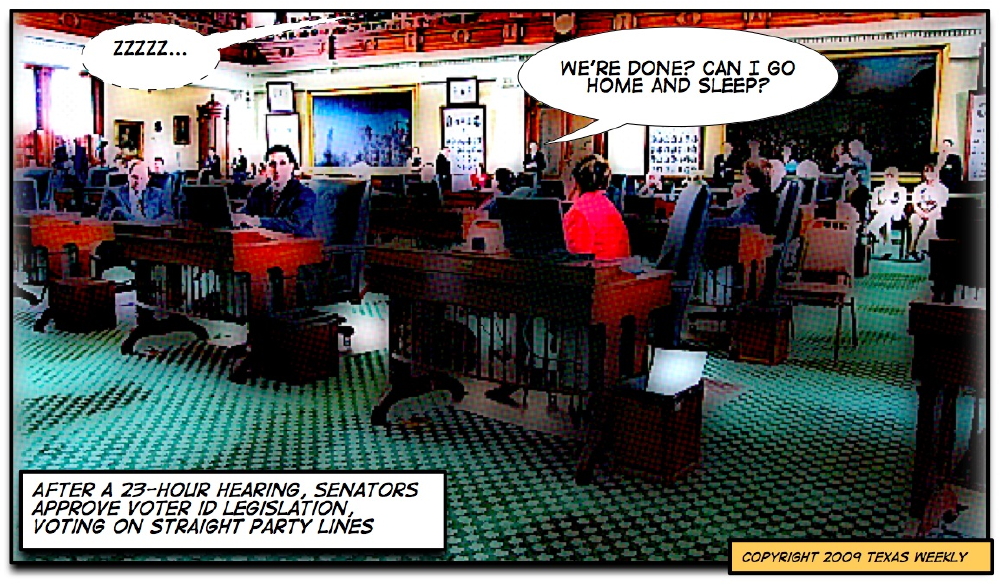
Ending a hearing that started 23 hours earlier, the Senate's Committee of the Whole heard its last witness at around 9 a.m. today and voted 15 minutes later to send the Voter ID bill to the full Senate. It was a 20-12 vote, with Lt. Gov. David Dewhurst voting with the rest of the Republicans against all of the Democrats.They'll vote on that next week — presumably in the same formation, but without a vote from the Lite Guv — and send the bill on to the House. Voter ID legislation has had a better time in the lower chamber in the past two sessions, but there are more Democrats over there now and it's outcome isn't as certain. The House has approved Voter ID bills in each of the last two legislative sessions, voting on (mostly) partisan lines. In 2005, 78 Republicans out-voted a group of 67 members that included four Republicans and 63 Democrats. In 2007, 76 Republicans voted for a Voter ID bill, while 69 members — including two Republicans — were against it. Both of those bills, having passed the House, died in the Senate. Passing it is a Republican priority. Stopping it is a Democratic priority. And both sides may be at that Hatfields and McCoys moment, where the fight's more important than the reason for the fight: If that's the case, they won't be able to sit down and figure out a compromise that lets both sides win a little bit. Last week, Republicans in the Mississippi Legislature killed a Voter ID bill there after it was amended to include 15 days of early voting (Texas has early voting already; Mississippi doesn't). Lawmakers here have talked about possible changes to this bill — one, frequently mentioned, would allow voters to register to vote as late as Election Day.

Cast of characters: Robert Duncan, Troy Fraser, Royce West, Hans von Spakovsky, Eliot Shapleigh, Leticia Van de Putte

Gov. Rick Perry says the state should turn down $555 million in federal stimulus money tied to unemployment insurance, because the requirements are too strict.Perry has been mulling the issue for several weeks but announced at a Houston business that the costs of adding what the federal government requires — the estimated costs are $70 million to $80 million annually — outweigh the benefits of taking the federal money. "Texans who hire Texans drive our state’s economic engine," he said, announcing his decision. "During these tough times, Texas employers are working harder than ever to move products to market, make payroll and create jobs. The last thing they need is government burdening them with higher taxes and expanded obligations. I am here today to stand with Texas employers and the millions of Texans they employ to resist further government intrusion into their businesses through an expansion of our state’s unemployment insurance program." Perry said the required changes to UI would "force employers to change their hiring practices" and would raise their taxes, force them to raise prices and make it harder for them to cope with the current economy. "The math is pretty simple," Perry said. "Employers who have to pay more taxes have less money to meet their payroll, hire new employees, to grow their business. It's really that simple. If Washington really wanted to help... they would send the money with no strings attached, just like they did in 2002." And he said Washington is trying to force the state to accept policy changes the Legislature has repeatedly refused to accept. The feds want the state to change the base employment period used to figure benefits, and then to select two things from a list of options that includes allowing out-of-work part-timers to collect benefits if they're seeking new part-time jobs (currently, they have to say they're seeking full-time work to get benefits), allowing "trailing spouses" to get benefits if they lost their jobs following their spouses to new jobs in different locales, allowing people in approved training programs to collect benefits, and so on. Perry is betting that Texas voters — Republican primary voters in particular — are unhappy taking a partially funded federal mandate and about the federal stimulus package in general. And he can say, honestly, that the increased costs forced on unemployment insurance by new federal standards will eventually be funded with taxes on Texas businesses. After he said he's against taking the money, he appeared on Fox News. They played a sound bite from Vice President Joe Biden: "Six months from now, if the verdict on this effort is that we've wasted the money, we built things that were unnecessary or we've done things that are legal but make no sense, then, folks, don't look for any help from the federal government for a long while. Perry's reaction: "If the message is 'We're not going to help you any more,' I hope we can hold him to that." But the politics aren't simple. Another argument for voters: Taking that $555 million would significantly lower an impending deficit tax on Texas businesses. State officials estimate UI will be underfunded by $750 million by October, triggering a deficit tax on Texas employers (or state borrowing that would be repaid by those employers). The cost of the changes the feds require in return for that money puts the break-even point on this deal at seven years ($555 million divided by $80 million). In the meantime, it amounts to $555 million in tax money that's being shunned by the state — used wherever else the federal government wants to use it. And it means $555 million in deficit taxes to be collected from Texas employers during a recession. Perry doesn't get the final say-so on this; legislative efforts to work around him are already underway. Mechanically, that would require two-thirds votes in favor of the benefit changes in both the House and the Senate. Two-thirds is what it takes to override a governor's veto (which hasn't happened since Bill Clements' first term). The soft approach — passing legislation that attempts to cut the strings attached to the federal package — is coming from Sen. Kevin Eltife, R-Tyler, Rep. Tan Parker, R-Flower Mound, and others. The hard approach got its first look within a couple of hours after Perry announced his opposition: A House committee on the stimulus voted 5-1 to proceed with plans to change UI and use the federal funds over the governor's objections. • Background: How the stimulus affects Texas... Proponents urge the governor to take the money... and current unemployment numbers • Reactions: Texas Workforce Commissioner Tom Pauken, a Perry appointee whose been trying to craft legislation allowing Texas to take the money and to revert to its current UI program when the federal money runs out:

"I agree with Governor Perry that there should be no strings attached to the additional federal funds made available to Texas, pursuant to the so-called unemployment insurance modernization legislation. My efforts have been directed at developing a legislative approach which would allow Texas to get back our tax dollars without imposing any additional financial burden on Texas businesses after the federal funds run out. The Governor believes taht the Obama Administration won't permit Texas to do that. I concur with Gov. Perry that the federal government has no right to dictate to Texans changes in our state law that will last after the federal funds are long gone."
U.S. Sen. Kay Bailey Hutchison, who's preparing a bid for governor against Perry in next year's GOP primary:
"I hope that the Governor has carefully thought through the potential outcomes of today’s decision. With the state unemployment fund dangerously close to falling below the legal threshold, it is imperative that the Governor does nothing that potentially burdens small businesses with higher taxes in tough economic times or pushes those who have recently become unemployed and their families into further economic peril."
Rep. Jim Dunnam, D-Waco, after his committee voted 5-1 to pursue the UI funding over Perry's objections:
"Today, the Select Committee on Federal Economic Stabilization Funding recommended that the Legislature make all necessary changes to receive unemployment compensation funds from the Federal stimulus package. This recommendation is the first step in trying to reduce the economic burden for unemployed Texans. In January alone, Texas lost 78,500 jobs — the largest one month loss on record. Since the economic downturn began, over 250,000 jobs have been lost. Right now Texans are struggling, and they deserve the Legislature's full attention. I look forward to working with my colleagues in the House and Senate to bring this $550 million in unemployment compensation to Texas."
Texas AFL-CIO President Becky Moeller, whose unions have been pushing for changes to UI for years:
"Today Gov. Rick Perry said to the workers and employers of Texas: 'What crisis?' The governor's decision to reject $555 million in federal unemployment insurance funds available in the economic stimulus package amounts to a callous statement to tens of thousands of Texans who are losing their livelihoods that Texas does not have their backs. Playing 2010 or 2012 politics when Texans are suffering in 2009 has nothing to do with good public policy. The Texas AFL-CIO has worked with lawmakers who are carefully exploring the ramifications of accepting the UI funds. The stimulus package essentially covers for seven years any cost associated with making UI benefits more accessible to workers who have lost jobs through no fault of their own. If today's decision stands, employers will start paying an additional $555 million in taxes in January, courtesy of the governor, and Texas workers who desperately need help will be left to fend for themselves. In short-circuiting the legislative process, Gov. Perry is telling employers that it is better to pay $555 million extra to keep the current lousy UI system than to pay an incremental increase seven years from now for a better system. Here’s hoping the Legislature sees this issue differently. This is no time to demonize workers who are victims of the worst economy America has seen since the Great Depression."
Sen. Kevin Eltife, R-Tyler, who filed legislation that would change the state's rules to meet the federal requirements, and then change them back when the federal money runs out:
"My legislation includes a sunset provision so that we will automatically revert to our current law once the federal funds are discontinued. In these difficult economic times I think it is important to do everything we can to help those who have lost their jobs, and at the same time, keep the burden on business to a minimum. That's why, with our unemployment fund running low, I think we should accept the stimulus money with a sunset provision. I understand and appreciate Governor Perry's concerns. I am hopeful he will consider this approach."
Sen. Rodney Ellis, D-Houston:
"Governor Perry's decision to reject the $555 million in unemployment aid is simply deplorable. Texas families are hurting and are worried about how they are going to keep their homes and pay their bills. Today, Governor Perry told them: 'good luck with that.' If the Governor won't do his job, we'll have to go around him, and I am prepared to do just that."
Texas Association of Business President Bill Hammond, an early and loud opponent of the federal UI stimulus:
"In return for receiving $556 million dollars from the federal government, Washington demanded radical, permanent changes to our state's unemployment laws. These changes would have left employers on the hook for a new job tax that would have cost employers hundreds of millions of dollars with no end in sight. Higher costs for employers mean fewer jobs are created, leading to a weakened economy – which is not good for Texas or Texas workers. Governor Rick Perry deserves praise for rejecting this money and doing what's right for Texas. These funds had strings-attached that would have tied up our state for years to come. Our state is home to one of the most robust economies in the world because of fiscal responsibility, fewer taxes and the character of our hardworking men and women. Governor Perry's decision to reject this portion of the federal stimulus package will safeguard Texas’ successful economy for years to come."
Sen. Kirk Watson, D-Austin:
"Refusing this money is not merely short-sighted or economically questionable – it demonstrates the height of denial about the challenges confronting this state and its people. Texans, through their taxes, will still be responsible for every dollar that the federal government wants to send back to this state. This is economic development money, and it's meant to help Texans who need it the most. The Governor’s own Workforce Commission Chairman, Tom Pauken, told the Senate Nominations Committee last month that the state should accept this money. While doing so would require some policy changes to the state’s unemployment program, Chairman Pauken noted that the Legislature would have ample opportunity to undo the changes in future years if it needs to. It's unfortunate that his good advice has been ignored. Texas' economy is slowing down, as is the rest of the nation's. More and more Texans are losing their jobs, and the Federal Reserve forecasts that hundreds of thousands more will become unemployed in coming months. Now more than ever, we need a plan for coping with Texas' growing unemployment problem, and we need resources to pay for it. Refusing this stimulus money brings Texas no closer to that plan. It simply moves the state deeper into the economic crisis threatening so many every-day Texans. It's now incumbent on the Legislature to address this issue directly and stand up for the workers, families, and businesses who are being buffeted by this recession."
Rep. Garnet Coleman, D-Houston:
"Governor Perry ran Texas into the ground by suspending the tax on business that goes to the unemployment fund. That short-sided act has helped to deplete the fund by October. Governor Perry will run us further into the ground if he does not accept the unemployment insurance component of the federal stimulus. The Governor is costing Texas business owners close to $1 billion. Texans who have lose their jobs in this economy deserve to receive the unemployment benefits that they have paid taxes towards. We should not let this money go somewhere else."
Former House Appropriations Chairman Talmadge Heflin, now an analyst with the Texas Public Policy Foundation:
"Legislators must keep in mind that every additional dollar that Texas employers have to pay for people who aren't working is one less dollar available for job creation and economic recovery,” said Talmadge Heflin, Director of the Foundation’s Center for Fiscal Policy. “We are glad that Gov. Perry has chosen to keep our state’s focus on those goals, as they are the best path forward for the people of Texas. Employers will likely see an increase in their unemployment taxes even if we were to accept these funds to shore up our unemployment trust fund balance. The issue is whether Texas employers should continue to pay these higher unemployment taxes long after our economy has recovered. We agree with Gov. Perry that they should not."
Don Baylor Jr., an analyst with the Center for Public Policy Priorities:
"Our unemployment insurance system is an essential public structure that keeps families and the Texas economy afloat in tough times. The governor’s suggestion today that Texas should pass up help from the federal government to repair our cash-strapped system is misguided. Without this federal money, Texas businesses face increased unemployment insurance taxes in bad times, and without the modest reforms in state law required to get the federal money about 45,000 Texas workers will go without unemployment insurance. Texas covers the smallest percentage of unemployed workers of any state. Four-out-of-five unemployed Texans are not eligible for unemployment. We urge the governor to keep an open mind. Texas lost 74,400 jobs – the ninth-largest numbers of jobs lost in any state – from October 2008 through January 2009. Our unemployment rate is already bad and may be worse by the time legislation arrives on his desk to sign. The governor needs to let the legislature do its job and not get ahead of the process. We urge the Legislature to keep moving forward and to send UI legislation to the governor that qualifies Texas for the federal funds. We urge Texans to weigh in with their representatives and senators as well as with the governor. Texas businesses and Texas workers will be hurt if Texas doesn’t take this federal money. Texans need to speak up."
NFIB/Texas Executive Director Will Newton:
"NFIB/Texas reiterates its position today on creating programs with federal stimulus dollars that will require funding after the stimulus money is gone. We believe stimulus funds should be used for one-time expenditures that will not require long-term commitments when the money has run out. The state of Texas must reject efforts that may mandate that state lawmakers alter Texas unemployment insurance statutes in a manner that may further burden businesses well into the future. Federal requirements under the stimulus package would add an additional $80 million to the UI program’s annual cost -- a cost that will have to be paid by Texas businesses and a cost they simply cannot bear. We understand that any expanded benefits – to part-time workers, for example – will need to be continued when the money runs out. States that accept the stimulus money won’t be allowed to reduce benefits later. This will simply cost Texas jobs and further curtail business expansion. We need to know that there will be no strings attached to the federal dollars we receive for our unemployment insurance fund. Otherwise, those strings will end up doing more damage to our state’s economy in the long run. The money to cover these extended benefits will have to come from somewhere, and we fear that a likely source will be a payroll tax on small businesses already struggling in this economic climate."
Texas Democratic Party Chairman Boyd Richie:
"First, the Governor compared out-of-work Texans to junkies, and now he's using them as political pawns to appeal to the talk show bosses that drive the agenda of Perry's heartless Republican base. We don't need a right-wing candidate masquerading as Governor; we need a leader who will work with mainstream Texans in a bipartisan effort to rebuild our economy. Governor Perry's failed policies have already put our state unemployment fund on the verge of bankruptcy, and now he wants to compound that failure by sending our federal tax dollars to help the unemployed in other states while hardworking Texas taxpayers are losing their jobs. It's shameful that Rick Perry would rather play politics to keep his job than help Texans who have lost their jobs."

Expanding pre-kindergarten from half-day to full-day would, according to supporters, cut the school dropout rate, help parents hold their jobs, significantly increase student achievement, and yield an economic return of $3.50 for every dollar invested.

It would also cost about $5,000 for each kid in the program.

The Senate sponsor, Sen. Judith Zaffirini, D-Laredo, said the bill would allow districts to voluntarily expand their half-day Pre-K to full-day Pre-K for currently eligible four-year-olds. They wouldn't add to the list of kids currently eligible, at least at first.

Schools could run their own Pre-K programs, but would have to use at least 20 percent of their funding to contract with private providers that meet the program's standards. They'd get a funding boost, too: The regular allocation for a child in school, plus a multiplier of 20 percent (in school finance lingo, they'd add a 0.2 "weight" for each kid).

The money would go directly to the school districts and not to private childcare providers — a change that Zaffirini said was meant to placate opponents of school voucher programs. That caught the attention of Sen. Florence Shapiro, R-Plano, who chairs the Senate Education Committee and who has tried unsuccessfully to pass school voucher bills: "We will utilize that language at other opportunities."

There's another difference between this and a voucher program. Here, school districts would decide which private providers were admitted to the programs, and the choices would belong to the districts. In a traditional "school choice" bill, that choice would belong to parents of a student, who'd be allowed to choose between public and private institutions, using state money to pay for it.

The biggest obstacle is the cost. The legislative fiscal note says Pre-K would cost $623.1 million in the first two years. The costs would rise from there, reaching $426.4 million in year three, $506.2 million in year four, and $515.3 million in year five. "It is a very costly, very expensive piece of legislation," Shapiro noted. The estimators think about 89,000 of the 200,000 kids in the current Pre-K program would be eligible for full-time Pre-K; their school districts would have to participate (it's optional), and then each parent would decide what to do — stay in half-day, go to full-day, or opt out.

"The committee substitute will reduce that," Zaffirini said of the fiscal impact, since it delays implementation of the full-day program by one year (which moves half the cost out of the budget being written now and into the next one). She also said she could tweak the funding formulas to make them less expensive to the state (and less lucrative to local school districts) than those in the regular bill.

Zaffirini has 10 co-sponsors in the Senate. The House version of the bill — sponsored by Rep. Diane Patrick, R-Arlington — has 64 co-sponsors, including Rob Eissler, a Republican from The Woodlands who chairs the Public Education Committee that will hear the bill as early as next week. The Senate committee left it pending, because of the fiscal note.

While senators just a few blocks away bloodied one another in a racially charged debate, a panel of fresh-faced representatives were talking as if they'd never heard the phrase "voter photo ID" before. However, some candid moments did emerge, with reminders that politics in Texas is still a contact sport.

Nine state representatives, nearly all of them rookies or sophomores, waxed long about ideals and cross-aisle collegiality during a roughly 90-minute discussion co-moderated by Rep. Patrick Rose, D-Dripping Springs, and former Rep. Corbin Van Arsdale, R-Tomball.

The lineup included Reps. Carol Alvarado, D-Houston, Rafael Anchia, D-Dallas, Ellen Cohen, D-Houston, Brandon Creighton, R-Conroe, Kelly Hancock, R-North Richland Hills, Carol Kent, D-Dallas, Susan King, R-Abilene, Eddie Lucio III, D-Brownsville, and Diane Patrick, R-Arlington.

Panelists largely concurred that writing the state budget is the most important issue of the session, as it usually is, but even more so considering the national recession and anticipated influx of billions in federal stimulus funds.

Figuring out how to maximize stimulus funds has dominated representatives' time so far this session, Hancock said.

"Chances are it could still be a work-in-progress in the last days of the session," he said, not ruling out a special session to allocate the federal money.

King was the only panelist to hint that Texas might not take all stimulus funds offered, as Gov. Rick Perry has been warning for weeks.

"We have not been basing our decisions completely, solely on the stimulus package," said King, a member of the House Appropriations Subcommittee on Education.

When asked what the biggest change in politics has been since Lyndon Baines Johnson was in the Oval Office (this took place at the LBJ school on UT-Austin's campus), Alvarado and Anchia mentioned the increased diversity among legislators.

There's still a long way to go on that, Cohen responded, saying only 37 of 150 House members are women and calling out House Speaker Joe Straus for not putting any women on the tax-writing Ways & Means Committee. Cohen also said having part-time Texas legislators prohibits normal working folks from seeking state office. She said the idea that Texas has a "citizen Legislature" is an "illusion."

"We represent our districts in the Legislature. But we don't represent our state on the Floor," Cohen said.

It took an audience member — the last of three called on for questions — to raise the specter of voter photo identification, asking if panelists thought the House "can avoid spending days on the topic and get to important issues."

Anchia, the Democratic face of opposition to the legislation in the House over the past few years, strongly criticized voter photo ID, calling it "voter suppression." Lucio also spoke against it. Republicans on the panel remained silent.

Nobody mentioned (as Sen. Troy Fraser, R-Horseshoe Bay, had done earlier, during Senate debate) alleged voter fraud in the 1948 election on behalf of the school's namesake, who won a U.S. Senate seat that year, and later, the Presidency.

This week marks the end of the bill-filing period in the Legislature (though members who ask for late filings are rarely denied). And it's the end of the first 60 days of the session, when legislation can't be considered by the full House or Senate unless the governor declares it an emergency. Nothing's made it to the floor of the House yet other than memorial and congratulatory resolutions (only three bills have been reported out of House committees; the first one would put live broadcasts of the State Board of Education on the Internet). And the Senate has passed exactly one bill — an initial run at repairing the state's badly broken safety net for developmentally disabled Texans (the upper chamber's committees got started earlier and have approved 69 bills for consideration by the full Senate).

The Texas Legislative Service has been keeping a running tally and finds bill filings up 20 percent — 1,011 bills — over this same point in the 80th Legislature. The breakdown: 4,071 bills have been filed in the House, an 18 percent increase, and 2,075 have been filed in the Senate, up 24 percent from two years ago.

• The U.S. Supreme Court decided in a North Carolina case that states are not required to protect minority voters in districts where they aren't in the majority. And they quickly got into the sort of parsing we'll all be interested in two years from now, when Texas is redrawing maps. To wit: You've got Majority-Minority Districts, where minorities are in the majority. Still protected, if certain conditions exist. You've got Influence Districts, where minorities are able to influence the outcome of an election even if it doesn't go to a member of that minority. Those aren't protected. There are Coalition Districts, where more than one ethnic minority can combine to elect a minority legislator. And there are — this is the category central to this new decision — Crossover Districts. That's where a minority is relatively close to, but still below, 50 percent of the voting age population. And states, according to the Supreme Court's new 5-4 decision, aren't required to draw those districts or to protect them.

• After Attorney General Greg Abbott dodged the Senate Committee of the Whole's hearing on Voter ID, Rep. Mark Homer suggested the state's top lawyer be replaced on the Legislative Redistricting Board. Abbott's out on the COW meeting was that he shouldn't testify since he might have to represent the state on Voter ID if it should ever land the state in court. Homer, D-Paris, sees that as fodder for a proposed constitutional amendment that would replace the AG on the LRB, putting the Texas Commissioner of Agriculture in his place. That's the five-member board (AG, Lite Guv, Speaker, Land Commissioner, Comptroller) that decides the state's redistricting maps when the Legislature locks up. And redistricting maps — no matter who draws them — always, always, always end up in court.

• If you run out of booze on Sunday, it's against the law to replenish your liquor cabinet. And a new poll says most Texans want to keep it that way. Austin-based Baselice and Associates, polling for the Texas Package Stores Association, found that 53 percent of Texans oppose Sunday liquor sales and 30 percent support ending the prohibition (801 registered voters, February 24-26, +/-3.5 margin of error). Three-fifths of those folks (61%) said the liquor stores should be closed on Sundays for religious and moral reasons, and 81 percent say the current hours for those stores give people "enough time and convenience to shop for liquor." Did we mention the package stores don't want to stay open on Sundays?

• The new version of the Texas Tomorrow Fund — the state's prepaid college tuition fund — attracted $239 million in contracts during the six months ended February 28, according to Comptroller Susan Combs. That's almost 13,000 kids.

• Semi-quietly underway: Railroad Commissioner Michael Williams, a Republican contender for the U.S. Senate if and when Kay Bailey Hutchison gives up the chair, will be in Washington, D.C. raising money for that effort next week. State officeholders can't raise money during a session for state political accounts, but they're not barred from raising money for a federal race.

• File this under things we didn't imagine we'd ever see. A direct and entire quote from an email: "The Texas Education Agency is now Twittering. Follow us at: http://twitter.com/teainfo."

Redistricting is a subject that can get lawmakers' blood boiling, their hearts racing and their dander up. Unfortunately, Texas voters are less passionate about the redistricting process, showing little interest until the partisanship and fractiousness that always results during redistricting makes headlines. The last time Texas went through the redistricting process, the Texas Legislature became such a laughingstock that Jay Leno made jokes about it on TV. I don't want that to happen again. On March 2, a bill that would change the method whereby we redraw Congressional district lines had its first public hearing before the Senate Committee on State Affairs. Senate Bill 315, which I authored, would bring to an end the divisive and highly partisan exercise that inevitably results in bad blood, expensive lawsuits, and gerrymandered Congressional districts, which are a disservice to Texans. Travis County, for example, was gerrymandered into three Congressional districts during the last redistricting process. This three-way separation of a single community of interest was unfair to both Travis County residents and those who live in the other counties that make up the Congressional districts. In addition to separating communities of interest, gerrymandering protects incumbents. Protected incumbencies discourage challengers, so voters' choices could be limited to a "token" challenger or to no choice at all. Since both political parties have proven conclusively that they are unable to resist the gerrymandering urge, Senate Bill 315 would create an independent bipartisan commission that I believe will bring a sense of balance and a semblance of fairness to redistricting. An independent commission also will allow the Legislature to attend to critical issues during a redistricting session, such as the one coming up in 2011, instead of indulging in bitter wrangling over Congressional districts. The bill calls for Republican members of the Texas Senate to select two citizens, for Democrat members of the Texas Senate to select two citizens and for the Texas House of Representatives to select four members in the same manner. At least two members of the eight-member commission would be from counties with relatively small populations. And none could be elected officials, political party officials or registered lobbyists. I have no doubt that each of the parties will choose members whose loyalty to their respective political party is as strong as horse radish. These eight Texans would select a non-voting ninth person to preside. Together they will draw fair, legal Congressional districts and decide on a map by majority vote. In case of a tie, the Chief Justice of the Texas Supreme Court would appoint another member to the commission, who could break the tie. Twelve other states already do this or something similar, and it works. The benefits of such a plan are obvious. The Texas Senate voted for an independent, bipartisan commission in 2005 and 2007. This year, if the bill passes both chambers and is signed by the Governor, Texans will no longer have to endure what we have gone through every 10 years for the past half century. Sen. Jeff Wentworth, R-San Antonio, has represented SD-25 since 1993.


Texas Weekly's Soapbox is a venue for opinions, spins, alternate takes, and other interesting stuff sent in by readers and others. We moderate submissions to keep crazy people out, and anonymous commentary is ineligible. Readers can respond (through the moderator) to things posted here. Got something to submit? We're interested in everything from full-blown opinion pieces to short bits to observations or tidbits that have escaped us and the mass media. One rule: Your name goes on your words. Call or send an email: Ross Ramsey, Editor, Texas Weekly, 512/288-6598, ramsey@texasweekly.com.

Political People and their Moves

Dan Bartlett, who's been at Austin-based Public Strategies since he left the Bush White House in 2007, is now the president and CEO of PSI. He's replacing Jeff Eller, who becomes a vice chairman of the firm (like Mark McKinnon) and who'll focus on its Washington operation.

John Tintera is the new executive director at the Texas Railroad Commission; he's been the interim since the beginning of the year and replaces Rich Varela, who retired. Tintera has been at the agency since 1990 and was a petroleum geologist before that.

Anita Givens is the Texas Education Agency's newest associate commissioner, with a portfolio that includes standards and programs, curriculum, textbooks and such. She's been "acting" in that position for the last several months.

Troy Alexander, the health and human services policy wonk for former House Speaker Tom Craddick, landed as director of the Center for Program Coordination, Policy and Innovation at the Department of State Health Services.

Matt Mackowiak is leaving Kay Bailey Hutchison's Washington office, where he's been a spokesman, to return to Texas. He says more details are forthcoming.

Recovering: Freshman U.S. Rep. Pete Olson, R-Sugar Land, after a fainting spell at the gym resulted in a heart pacemaker installation. He's 46, and reportedly doing fine.

Quotes of the Week

Skaggs, Fraser, West, Fraser, Davis, Seliger, Wells, and Straus

Adam Skaggs, an attorney with the Brennan Center for Justice, on the sort of cheating that would be prohibited by Voter ID legislation: "It doesn"t happen because the odds of getting caught are extremely high, the penalties are extremely serious and the payoff is miniscule."

Sen. Troy Fraser, R-Horseshoe Bay, introducing the bill: "Voter fraud not only is alive and well in the U.S., it's also alive and well in Texas."

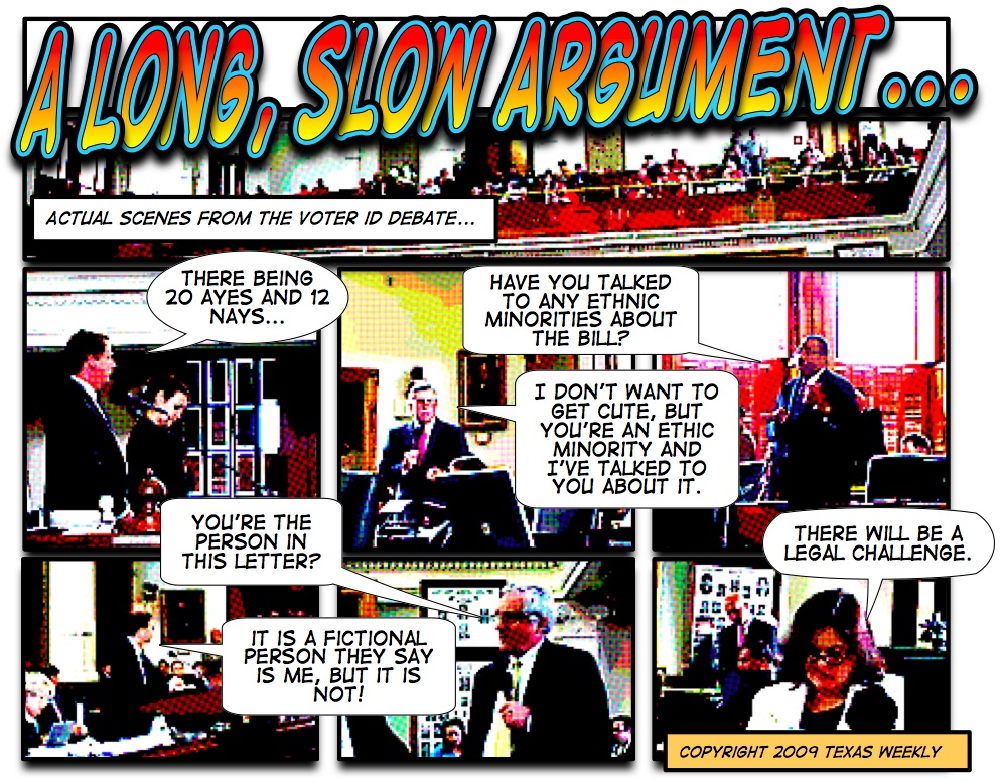
Sen. Royce West, D-Dallas, questioning Fraser about the bill: "Have you talked to any ethnic minorities about the bill?" Fraser, replying: "I don't want to get cute, but you are an ethnic minority, and I've talked to you about it."

Fraser, having difficulty making out questions from Sen. Wendy Davis, D-Fort Worth, during the Voter ID debate: "I have trouble hearing women's voices."

Sen. Kel Seliger, R-Amarillo, talking to the Austin American-Statesman after an all-night debate on Voter ID: "I'm just gonna email my wife and tell her I just spent the night with [Sen.] Leticia Van de Putte."

Keith Wells, Fort Worth's assistant emergency coordinator, quoted in The Dallas Morning News about helping victims of Gulf Coast hurricanes: "Everyone wants to do the right thing. But sometimes, it's a case of, 'It's not our disaster.' We're going to do the best we can to help folks. But we would like to get compensated."

House Speaker Joe Straus, quoted by The Dallas Morning News after a hernia operation: "If I were going to spill my guts on the floor of the House, I didn't want it to be through that procedure."