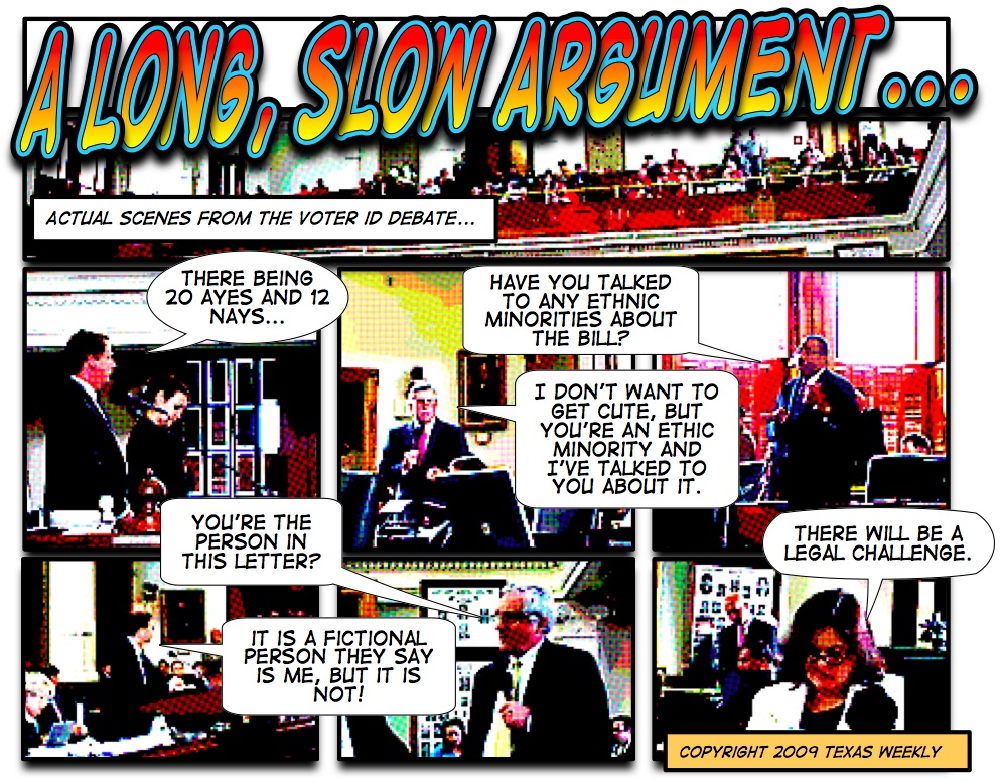
While senators just a few blocks away bloodied one another in a racially charged debate, a panel of fresh-faced representatives were talking as if they'd never heard the phrase "voter photo ID" before. However, some candid moments did emerge, with reminders that politics in Texas is still a contact sport.
Nine state representatives, nearly all of them rookies or sophomores, waxed long about ideals and cross-aisle collegiality during a roughly 90-minute discussion co-moderated by Rep. Patrick Rose, D-Dripping Springs, and former Rep. Corbin Van Arsdale, R-Tomball.
The lineup included Reps. Carol Alvarado, D-Houston, Rafael Anchia, D-Dallas, Ellen Cohen, D-Houston, Brandon Creighton, R-Conroe, Kelly Hancock, R-North Richland Hills, Carol Kent, D-Dallas, Susan King, R-Abilene, Eddie Lucio III, D-Brownsville, and Diane Patrick, R-Arlington.
Panelists largely concurred that writing the state budget is the most important issue of the session, as it usually is, but even more so considering the national recession and anticipated influx of billions in federal stimulus funds.
Figuring out how to maximize stimulus funds has dominated representatives' time so far this session, Hancock said.
"Chances are it could still be a work-in-progress in the last days of the session," he said, not ruling out a special session to allocate the federal money.
King was the only panelist to hint that Texas might not take all stimulus funds offered, as Gov. Rick Perry has been warning for weeks.
"We have not been basing our decisions completely, solely on the stimulus package," said King, a member of the House Appropriations Subcommittee on Education.
When asked what the biggest change in politics has been since Lyndon Baines Johnson was in the Oval Office (this took place at the LBJ school on UT-Austin's campus), Alvarado and Anchia mentioned the increased diversity among legislators.
There's still a long way to go on that, Cohen responded, saying only 37 of 150 House members are women and calling out House Speaker Joe Straus for not putting any women on the tax-writing Ways & Means Committee. Cohen also said having part-time Texas legislators prohibits normal working folks from seeking state office. She said the idea that Texas has a "citizen Legislature" is an "illusion."
"We represent our districts in the Legislature. But we don't represent our state on the Floor," Cohen said.
It took an audience member — the last of three called on for questions — to raise the specter of voter photo identification, asking if panelists thought the House "can avoid spending days on the topic and get to important issues."
Anchia, the Democratic face of opposition to the legislation in the House over the past few years, strongly criticized voter photo ID, calling it "voter suppression." Lucio also spoke against it. Republicans on the panel remained silent.
Nobody mentioned (as Sen. Troy Fraser, R-Horseshoe Bay, had done earlier, during Senate debate) alleged voter fraud in the 1948 election on behalf of the school's namesake, who won a U.S. Senate seat that year, and later, the Presidency.